
Behind every good menu is a system nobody sees
Behind every good menu is a system nobody sees
Pinch or scroll to look around
Before we dive into how The Home Kitchen System works, I’d like to give you a little background on how it all started.
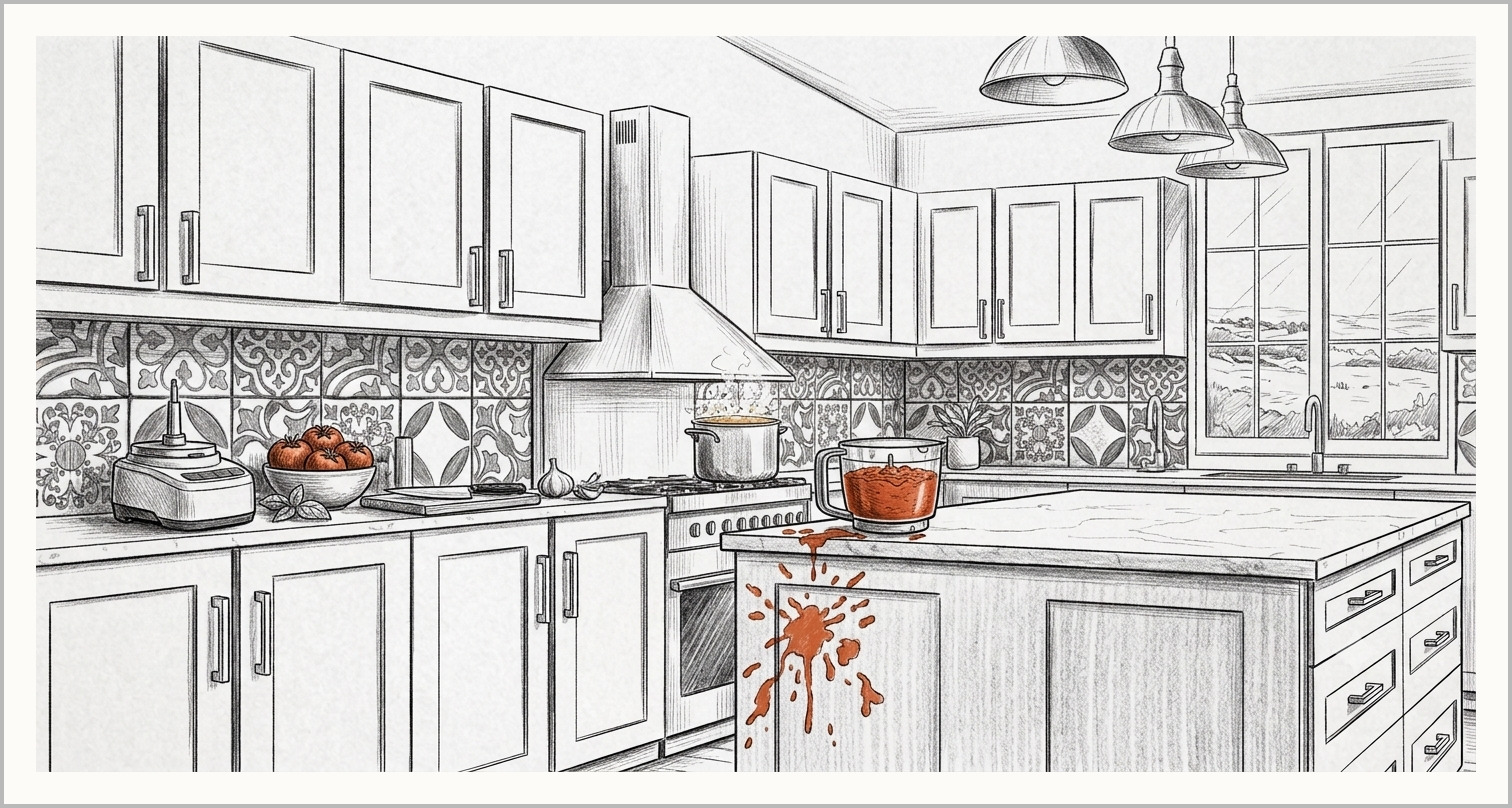
Not too long ago, we moved into our newly renovated house, complete with a brand new kitchen in the extension we’d added. I’d designed it myself — chosen the tiles, the cabinets, the worktops, the lamps, the fridge and freezer, the extraction — and I was thoroughly pleased with myself. White painted cabinets with a little detail on the front. Very smart.
The first time I actually cooked in the space, tomato sauce ran straight down the front of one of those cabinet doors. Standing there wiping it off, I found myself thinking about all the years I’ve spent in and around commercial kitchens, and wondered: how many people would still eat from their own kitchen if they saw it through the eyes of a health inspector?
Every commercial kitchen gets inspected by Environmental Health, and there are protocols you simply must follow; if a kitchen is bad enough, it gets shut down until it’s compliant. Every food handler has to complete a food hygiene course, and on top of that, each kitchen keeps its own practices and procedures on file, just to prove due diligence. In the UK you can even look up the hygiene rating of anywhere that sells or serves food before you’ve decided where to eat. So if you wouldn’t eat at a restaurant with a poor rating, why would you happily eat out of your own kitchen, where none of that applies?
These were the questions I started asking myself: How often is your floor swept and mopped? How long has that thing been sitting in the freezer? When did you last clean out the cutlery drawer? And if an inspector walked in tomorrow, would your kitchen pass?
I’ve never met anyone — including fellow chefs, and people who’ve worked in food service their entire careers — who keeps any kind of due diligence system in their own kitchen at home. Why not? It’s a boring subject, I suppose, and most people can’t be bothered. And yet so many of us read cookbooks cover to cover like novels, hunt down new food shops, research ingredients we’ve never heard of, buy beautiful china and glassware and napkins that match, just so the table looks perfect for whatever we’re serving. We soak, sauté, flambé, chop and dice our way through the most elaborate dinner parties and Instagram posts going — and never once think about due diligence.
So, once I’d unpacked the last box and got myself vaguely organised, I dug out the food safety files I’d built up over my career — the manuals, procedures and checklists — and set about turning them into something that actually works in a home kitchen. That became The Home Kitchen System.
The flowcharts, the risk assessments, the HACCP diagrams — none of that survived the translation, and rightly so. The idea is to give you tools to work with, not bore you to tears. But underneath all the paperwork there’s some genuinely useful detail and a fair bit of common sense, and I’ve repackaged it as habits that will keep your kitchen running as smoothly, safely and — dare I say it — as sparkling as a Michelin-starred one.
At the centre of all this is the Meal & Prep Planner — the star of the show. It’s your menu. A restaurant is just a room full of tables and chairs until it has a menu; the menu is the purpose of the entire operation, and it shows what the place actually does. The person sitting at the table doesn’t need to know what goes on behind the scenes, but the menu can’t deliver without it. The same goes for your Meal & Prep Planner: behind it sit the practices and procedures that make it work — storing and labelling food, temperature guidelines for cooking and storing, the Golden Rules and the Kitchen Habits.
None of this is a set of legal requirements, or another app to download. It lives online, so you can read it on your phone, tablet or computer, and download and print the planner and lists.
Let’s begin “front of house”, with the menu. What comes out of your kitchen every day is your menu — a reflection of how you live, or how you’d like to live — so let’s start creating yours with the Meal & Prep Planner.
In a production kitchen turning out hundreds of meals every day, we worked to an operations plan covering every employee’s day, from the prep to the washing up. It was quite rigid — it had to be. The Meal & Prep Planner grew out of that plan: I kept some details, the menus and the pre-prep — the jobs you do days or even weeks ahead — and left the rest of that ops plan in the professional kitchen. This planner works for weekly, fortnightly or even monthly menus, so that you can plan, prep, and eventually be organised enough that you never have to stand in front of an open fridge staring into the abyss wondering what on earth you’re eating tonight.
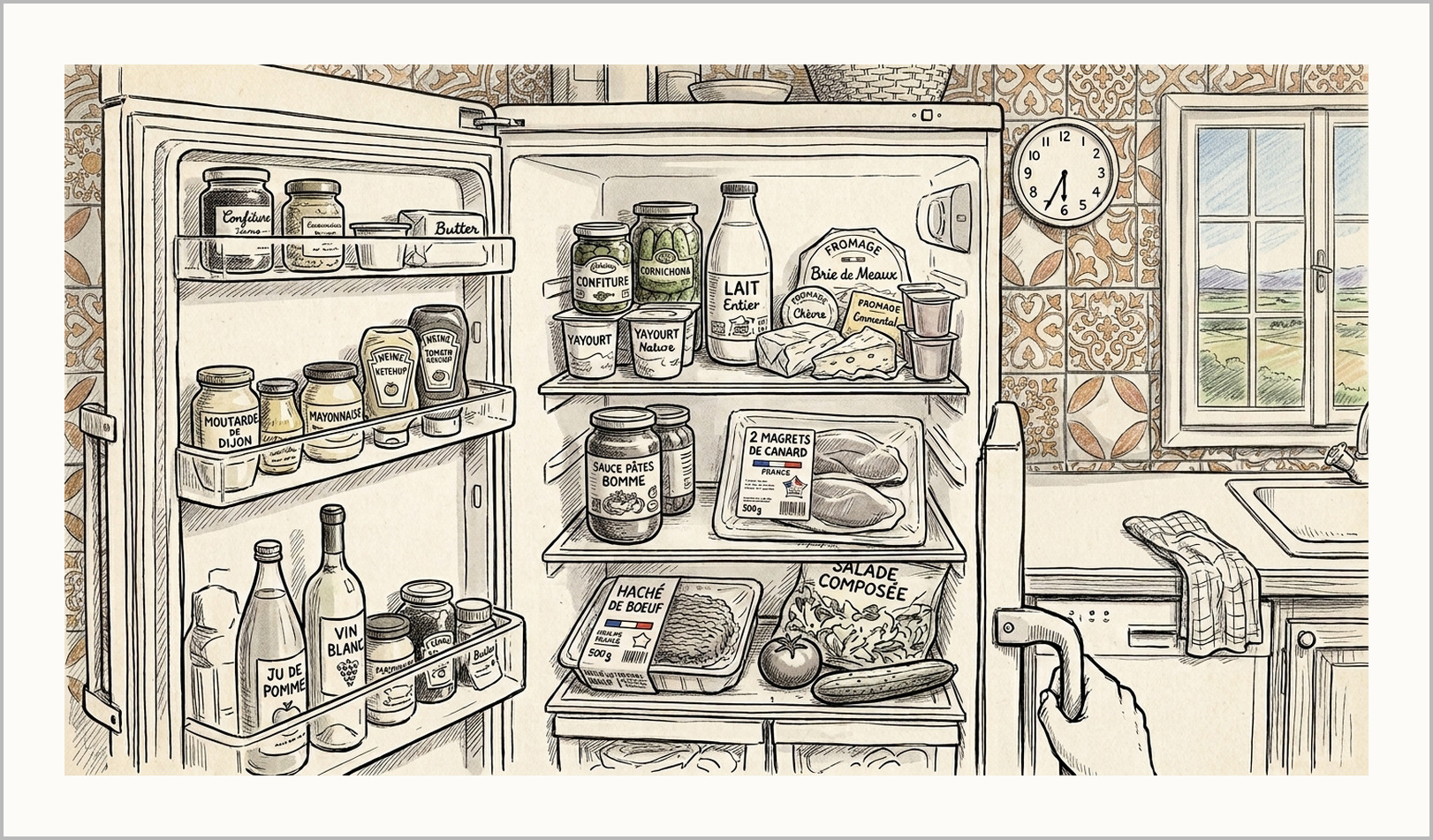
This is how it worked. I used to write our menus fortnightly, based on what was already in-house, the stores — freezer, fridge and dry stores — and from there I would fill in the gaps and complete the menu for the week or the fortnight. The gaps between what we already had and the rest of the menu became our food order, and in your case, that gap becomes your grocery list.
When I started writing the Meal & Prep Planner for The Home Kitchen System, I did some research first, because I was well aware that plenty of websites, especially food sites, give away free meal planner printables, and that Pinterest absolutely loves meal prep. So I downloaded a few of them and I was underwhelmed, to say the least. The best of them were seven boxes on a sheet of branded paper, and the worst were a stack of lines with the days of the week running down the left-hand side, and I found myself asking how anybody could possibly think that was a good way to organise a week of meals. Then I went looking at how meal prep itself is presented for home use, and I still haven’t seen anything with the level of detail this system has.
So I built the system backwards. I spent the time drawing it up and working out all the details, and then had the “aha” moment — hang on, what does the research actually say? As it turns out, the research largely backed up my theory about flexibility, but it also told me something I hadn’t expected, which is that most people will not successfully implement a system like this beyond week three. I sat with that for a few days and then restructured the planner again, this time with a full-on honesty position, and that position is this. When you are planning your meals a week out:
Chances are, you won’t cook seven nights a week. You’ll order a takeaway. You’ll look at Tuesday’s salmon and decide you really fancy a burger. You’ll try that new restaurant that has just opened — you know the one, with the great reviews.
Most people fail at week two or three because they are riddled with the Shoulds.
If I’m going to get organised, this is a good time to start eating properly, because I should. I’ll plan to eat more oily fish, because I should. I’ll take a lunch to work every day, because I should. Miranda is forever telling everyone how she feeds her family on whole grains and seeds — I’ll do that too. Because I should.
No wonder the system “fails”. The Shoulds turn into that’s too much work and I’m too tired, or worse — you plan, buy and prepare all of these Should meals and most of it ends up in the bin, not because it has gone off or tastes bad, but because nobody decides to take on a new eating habit one day and wakes up the next morning with the habit in place. Sadly, that’s not how habits are made.
So to get the best out of the Meal & Prep Planner, start by being honest with yourself, because rather than setting yourself up to fail, the system is built to let you be as flexible as you want to be. Or not.
My planner week will not look like yours, and it isn’t meant to. Deciding to get organised with your meals, your food storage and your shopping does not mean you have to change your diet and eating habits — being organised saves you time and waste whatever you happen to be eating.
It means many things to many people. When I decided to introduce the Meal & Prep Planner into The Home Kitchen System, I realised that eating properly would be raised, because apparently deciding to take on meal planning and prep can suddenly provide the motivation to start cultivating healthier eating habits. And if it inspires you, go ahead and do it!
However, I’m not going to get into what eating properly means to every one of us. This planner is not a tracking app or a diet tool. No matter how many times I read that a meal planner will help you make healthier choices, or promise delicious meals every day, it can’t. At the end of the day, a plan on a piece of paper cannot deliver delicious meals, make healthier choices for you, or suddenly produce nutritious food. Eating properly is your decision, and it is personal to you.
I have a friend who is a vibrant 93-year-old, who swears he has never eaten vegetables and isn’t about to start now. Yet he considers himself a healthy eater, and who can dispute that, when you consider his age and the fact he is still flying around the world on adventures!? So whenever I refer to eating properly, it is subject to your interpretation. For me, it’s about cooking my own food most of the time, sourcing natural ingredients, and maintaining balance with an “everything in moderation” approach. I make no judgements and I make no promises. This is a Meal & Prep Planner. Not a magic wand. It’s a tool to help you achieve your meal and prep goals, nothing more.
It is worth knowing, because it changes how you’ll use this. Your objective might be your weekly budget, or it might be your time, and stopping the daily run to the shops is really both. Or, you might try and eat well, and cook as much as possible. It might be none of those, and you simply want to feel organised, which is reason enough on its own.
Somebody who does a big shop at a frozen food supermarket every week already has a full freezer, and they can use this planner purely as a meal planner — no worries, it works whichever way suits you. But they’d be missing the half that pays. Buying a fortnight’s meals is organisation; cooking two batches of bolognese and putting one away is what gives you a Tuesday night in the bank, three weeks later. It’s called a Meal & Prep Planner for a reason: the prep is the part that pays.
If you’ve bought this system and are reading this, chances are, you aren’t doing this — yet. But that’s why we’re here: to work through the details. You don’t have to start all at once. Stock the freezer however you like, and start prepping one or two things a week alongside it.
Because on its own, a planner is just an empty grid with a logo on a sheet of paper. What makes this one work is everything sitting behind it. Knowing what is in the freezer and the larder — or pantry, call it what you want. Knowing what was labelled and when. Knowing what needs using this week and what can happily wait until later. That is your stock, and managing it is the main component of this system. The lists, the labelling and the Rotation Guide are the hows, and they come later; the planner reads from them. Without them you are back to guessing at half past six with the fridge door open, which is exactly what we are trying to avoid.
This planner works on the idea that regular prep builds you a library of sorts — meals already made that can be dropped straight into a week, freeing up valuable time and letting you and your family eat properly, rather than reaching for the takeaway menu because there’s nothing in the house.
That’s the theory. In practice, now that you have the system in your hands, your freezer is not going to magically fill itself with pots of bolognese, sausage stew and vegetable lasagne, because that takes time, energy and a bit of capital investment. Your Stock List starts empty too, and fills gradually. Writing down what you already own is a job the first time — even if it’s only a few items in the freezer — and after that, it’s an addition when something goes in and a line crossed off when something comes out.
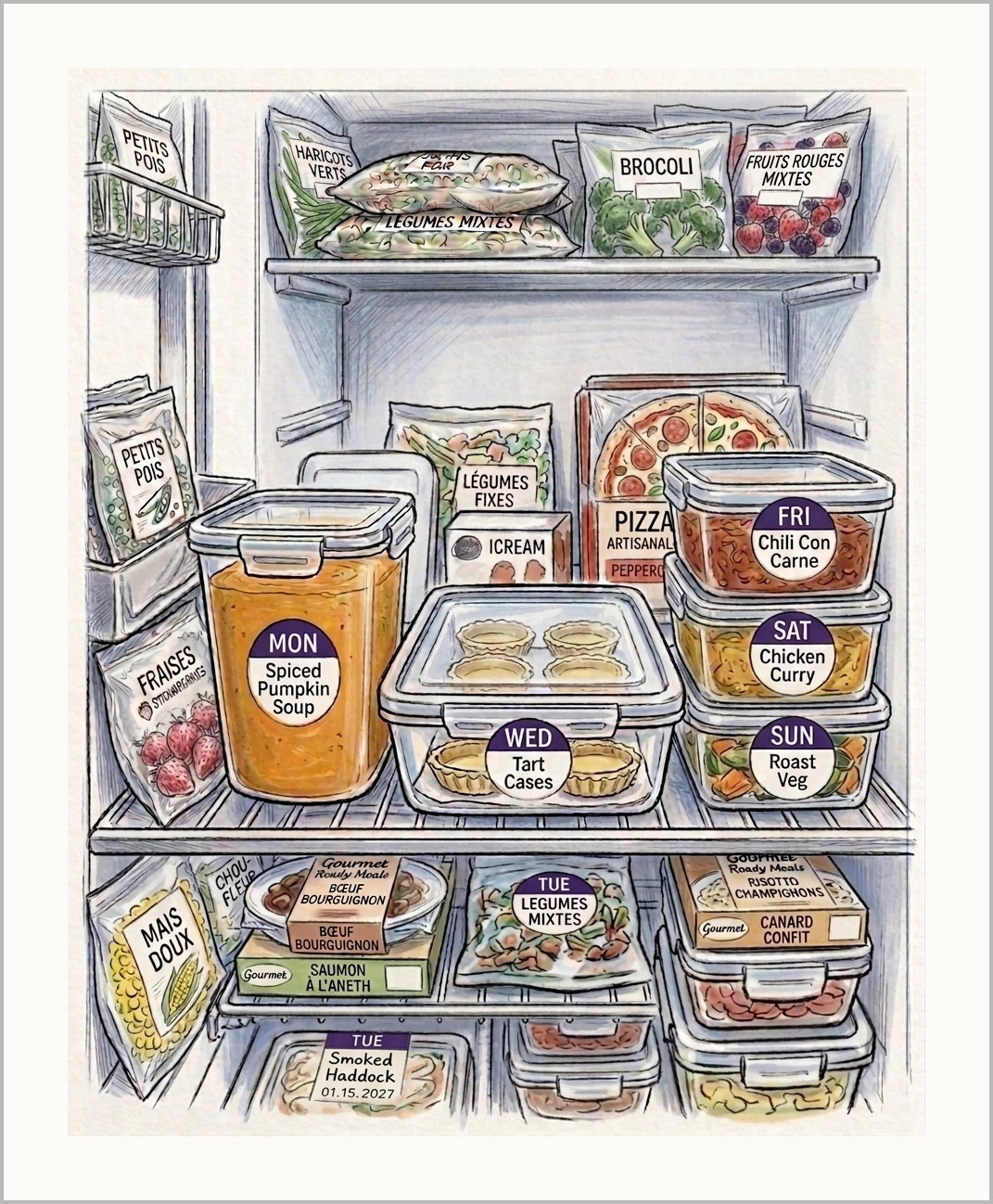
Realistically, you may want to approach this as a one, two or even three-month plan, and when the library is populated enough that you can work the planner the way you want to, you’ve won. But don’t be unrealistic about how long that takes. Start slowly. If that means one extra meal a week, do that. If three is comfortable, do three. How quickly your library fills is up to you. Make two batches of the bolognese — one for tomorrow night and one for the freezer. Spare Saturday afternoon? You could knock out a vegetable lasagne, a pot of minestrone, and turn some mince into pre-formed burgers.
Give yourself a Back-Up Plan. Plan B. Call it what you like.
What it really is, is permission. Permission to be flexible, without walking away from the planner altogether and without throwing food in the bin — because those are the two ways this normally falls apart. Somebody misses one night — the hot guy in the office on the second floor asks you out for a last-minute dinner and throws your plans off kilter — and the entire thing gets abandoned by the weekend. Or they stick rigidly to the plan they wrote on Sunday, resent every minute of it, and bin the salmon on Thursday when they finally admit they were never going to eat it.
Neither of those has to happen. The week is written down in front of you, so you can move it around — and what you do depends on what is sitting in the fridge waiting for you. If it’s chicken legs, they’ll keep a day or two, so the change of plan is simply a shuffle: swap Tuesday and Thursday over, and you still eat both meals. If it’s the salmon, it won’t wait, so cook it off — it only takes 15 minutes — and use it in a salad for lunch tomorrow, which is a lunch made rather than bought. Either way, nothing goes in the bin.
Then there are the times when the planner takes a night off and very little cooking is going to take place — the late night working on that project, or the delayed flight that had you getting home in the wee hours, long after anywhere was open for a takeaway. For those occasions you keep one or two things — a pizza or frozen meal that goes straight from frozen to oven, or pantry items like pasta and a jar of sauce. These items never go on your planner. Why? Plan them into a meal and one day you’ll reach for them and they won’t be there. I still keep a back-up of my own: a frozen pizza, a packet of pasta with a jar of pesto, dried mushrooms, saltine crackers, peanut butter, and a jar of good soup. Nothing that needs defrosting, because a back-up that needs a day’s notice isn’t a back-up.
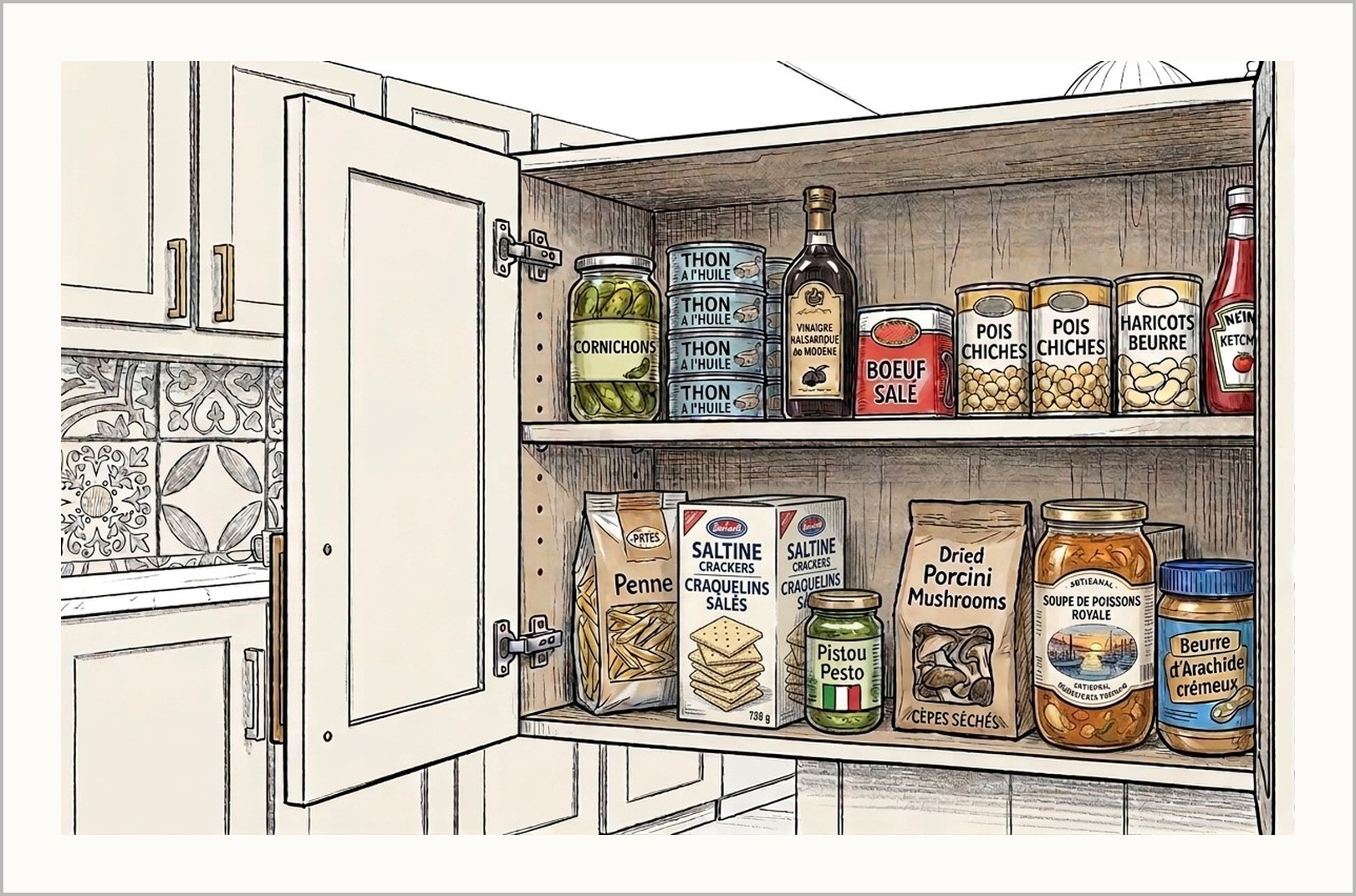
A rigid plan breaks the first time life gets in the way, and once it has broken, most people don’t go back to it. A flexible one bends and carries on.
So plan the week you are actually going to have, rather than the one you feel you ought to have. Be honest about what is in your freezer, honest about which nights you will genuinely cook, and honest about the night you already know will end in a takeaway — and write that in too, because it is your plan.
Next, we’ll see what a planned week can actually look like, then I’ll share my planner and walk you through how I use it to plan daily, weekly and even months in advance.
What a Planned Week Looks Like
Let’s walk through an imaginary week — a busy one, and deliberately detailed, so you can see how the pieces fit together. It is one household’s week, not yours; the method works just the same whether you are cooking for one or for sixteen. You’ll find this week on the Meal & Prep Planner example and the Freezer List example that follow — take a look at them before or after you read, and you’ll see it in action.
Let’s say you take a lunch to work (for the sake of this exercise, your daughter eats lunch at school and your partner at the office). A few weeks ago you used up that bag of carrots and made a carrot and coriander soup, and it’s in the freezer — you’ll remove it on the preceding Saturday for Monday’s lunch. Sunday afternoon you marinate those pork chops in the fridge for tonight’s dinner, and since you’re feeling productive, you make a leek and mushroom tart, put 300g (10½ oz) of borlotti beans in the fridge to soak and make six smoked haddock fishcakes for tomorrow’s dinner; you see those strawberry muffins in the freezer and grab them for breakfasts Monday and Tuesday.
You begin to fill in the rest of the week from what is already in the freezer. Because there is a vegetarian bolognese in there, you have spaghetti bolognese on the menu for Thursday night, so you would write in the Tuesday column to remove the 450g (1 lb) of that vegetarian bolognese sauce and put it in the fridge. Friday night is sausage stew (also in the freezer), so it’s marked to remove on Wednesday.
Monday lunch is the leek tart and a thermos of the carrot and coriander (cilantro) soup. Dinner is the smoked haddock fishcakes. When you get home in the afternoon after the gym, you put the borlotti beans on to boil — don’t forget to check on them every once in a while, and set the timer; they cook whilst you’re doing other things, like making a quick bowl of salsa and cleaning the corn on the cob to go with the fishcakes. When the beans are done, you drain, refresh and pop them in the fridge. Tuesday lunch is the rest of the tart — is there any soup left or maybe a quick green salad you’ve tossed together to go with it? — and a quick thought to remove the 2 x English muffins from the freezer and put those out with the breakfast items tomorrow. When you get home, you’ll pop a bird in the oven and your partner will help with the mashed potatoes and the green beans.
You fancy a glass of wine with your partner when they get home, so you’ve quickly opened a tin of tomatoes, popped in some chopped onions, minced garlic and a bit of veg stock (frozen in ice cube trays for quick use). The cooked borlotti beans are tipped into the tomato soup base; you chop up some veg from the crisper, and there’s a bag of spinach in the freezer — hang on! Grab a few leaves of basil from the garden, or a teaspoon of pesto from the fridge. Voilà! Twenty minutes later you’ve got a lovely soup on the go for lunches the rest of the week. And you’re free to sit and relax with your partner over that glass of merlot whilst the chicken is in the oven.
That last chicken breast makes two generous sandwiches for Wednesday and Thursday’s lunch, alongside the bean soup you threw together on Tuesday night. Wednesday you’ll go and watch your daughter’s football match and you’ll all get home too late to cook, so you’ll order a takeaway from your favourite Thai restaurant.
Thursday after work you’ll be going to a Pilates class so the bolognese you took out of the freezer will only require cooking some spaghetti. Your partner will grab a baguette from the bakery on the way home, then prepare the table and get a salad ready for dinner.
Friday you are meeting Antoine for lunch, and the sausage stew you took out on Wednesday means dinner is already sorted, but you do ask your partner to remove 3 x breakfast bars and one 90g (3 oz) bag of blueberries for the weekend and grab a baguette because the neighbours are over for dinner. Saturday morning your partner and daughter are making blueberry pancakes and you get a lie-in. You’ll use up some leftovers in the fridge for a late lunch, and get that chicken carcass you took out of the freezer on Thursday into a pot for some stock — you’ll be using it in the risotto for tomorrow, and don’t forget to put in the leek top and those carrot ends from the other day. You have a nap in the late afternoon, and get ready for your Date Night with your partner — you’ll be trying out that new seafood restaurant down on the waterfront.
The sausage frittata for Sunday brunch could have been prepared the day before, but you fancied a more leisurely day. The family will go for a walk whilst the frittata is in the oven. You’ll be working on that business brief in the afternoon and the two of them will get the ingredients together for the risotto dinner.
And that is a week. One productive Sunday, everything out of the freezer at the right moment, and not one evening spent staring into the fridge wondering what to make. You didn’t plan the activities — you allowed the space for them; you prepared to eat naturally around whatever you ended up doing, and your flexibility, and the things you always keep in, made that possible.
The Week Ahead
This shows what a planned week looks like in practice. Items in indigo are coming off your Freezer List.
| Week Commencing 05 Oct | MON 05 Oct | TUE 06 Oct | WED 07 Oct | THU 08 Oct | FRI 09 Oct | SAT 10 Oct | SUN 11 Oct |
|---|---|---|---|---|---|---|---|
| Breakfast | Blueberry Pancakes | ||||||
| Lunch | Carrot Soup, Leek & Mushroom Tart | Leek & Mushroom Tart Soup/leftovers? | Bean Soup, Chicken Sandwich | Soup & Chicken Sandwich | Out with Antoine | Leftovers | Sausage Frittata — brunch |
| Dinner | Fishcakes w/ Corn on the Cob, Salsa 3 people | Roast Chicken, Mash, Green Beans ② 3 people | Takeaway 3 people | Spaghetti, Veg Bolognese 3 people | Sausage Stew 5 people | Date Night D&A ④ | Prawn Risotto ③ |
| Prep | Beans in Fridge ① | Finish Soup ① | Make Stock ③ | ||||
| Freezer | Veg Bolognese Sauce 450g 2 x English Muffins | Sausage Stew 1kg | Carcass I | 3 x Breakfast Bars Blueberries 90g |
What’s in your freezer should never be a mystery.
| ITEM | WEIGHT / PORTIONS | DATE IN | USE BY | |
|---|---|---|---|---|
| Sausage stew | 1kg | 15 Aug | 15 Nov | |
| Vegetarian bolognese sauce | 450g | 18 Aug | 18 Nov | |
| Chicken carcass | I | 20 Aug | 20 Feb 27 | |
| Turkey meatballs | 12 x | 22 Aug | 22 Nov | |
| Strawberry muffins | 8 x | 31 Aug | 30 Nov | |
| Carrot & coriander soup | 325g | 04 Sep | 04 Dec | |
| Chicken carcass | II | 06 Sep | 06 Mar 27 | |
| Beef burgers | 4 x | 12 Sep | 12 Nov | |
| Pizza | 1 x | 15 Sep | 15 Dec | |
| Pumpkin purée | 465g | 18 Sep | 18 Dec | |
| Chicken carcass | III | 20 Sep | 20 Mar 27 | |
| Breakfast bars | 3 x | 22 Sep | 22 Dec | |
| Pulled pork | 1kg | 24 Sep | 24 Dec | One cook, two batches |
| Pulled pork | 450g | 24 Sep | 24 Dec | |
| Peas | 1/2 bag | 28 Sep | 28 Dec | |
| Spinach | 3/4 bag | 28 Sep | 28 Dec | |
| English muffins | 2 x | 30 Sep | 30 Oct | |
| Blueberries | 1 x 90g | 04 Oct | 04 Jan 27 | |
| Chicken carcass | IV | 06 Oct | 06 Apr 27 | |
When I was writing this section, I kept coming back to the same place over and over, trying to describe how it works. I struggled with it for weeks, because I kept thinking about all the different scenarios. Well, what if somebody is doing this? What if somebody is doing that?
And then I realised it is really not up to me. It is not for me to prescribe how this planner is used; it is up to me to familiarise you with how it can be used for your purposes. You are going to use it however works for you.
You might only use it at weekends. Two days a week. Whatever works. You might be running a busy household with three children and a dog. You might be a flight attendant who is away four nights out of seven and only needs the planner for the three you are home. You might be a nurse on rotating shifts, planning a week that starts on a Thursday, because that is when your week starts.
None of that matters. What matters is that you are eating what you want to eat, and eating properly — or whatever your own motivation happens to be for using the Meal & Prep Planner.
You may want to start slowly. And once you realise what you have got and how simple it is to manage, you will work the Meal & Prep Planner any way you want to run it.
Once you get it, you get it.
Then I have done my job.
Now, let me walk you through how I use my planner.
I print a few blank Meal & Prep Planners and spread them out — the current week and the next few weeks — so I can see a month, five weeks, whatever I need for my planning. Why do I do that?
Because menus work on a weekly basis. They never end, because we never stop eating — until we do.
Because to be efficient, I want my meals planned along with my grocery lists, so I don’t spend hours wandering the aisles of the grocery store, or have to run out every other day for missing ingredients.
Because I always have a week on the go and at least the first part of the following week already planned.
Because we have a busy lifestyle, and if I’m cooking for friends — or prepping for the freezer, or testing recipes — that needs to be planned.
Because I like to spread my planners out and make notes in the margins as ideas pop into my head — my planner lives on the clipboard, and I refer to it every day.
And because I don’t want to repeat meals too often. Sure, we have our favourites, but I like to keep the menu changing, so we eat a good balance of foods — enough fish, for example. My old planners make that easy: I’ve already worked out a good balance of meals across the weeks, I know what we like, and at a glance I can see which recipes we tried and don’t fancy repeating.
This is where the extra sheets earn their keep, because they let you plan ahead. Take a blank Meal & Prep Planner and put a date on it — the date of your dinner party, or a date you’ve set yourself as a goal to fill the library. Then work out your menu for the party, or write down the meals you want to include in your pre-prep goal. I like to note the menu, or the meals for my goal, in the top margin of the week of the party or the goal date, so I can refer back to it. Now print a blank planner for every week between now and that date, and date each sheet — in my planners below, that’s four weeks. Then work backwards, slotting the prep for your party or goal into the weeks leading up to it. You’ll notice I’ve written each week’s prep in the top margin. I have not allocated when I’ll do the prep in the week; I have allocated that I will do the prep in those weeks. Leave those planners blank apart from the dates and the prep notes, and keep them on the clipboard until you come to plan those weeks properly. By the time you get there, the prep is already scheduled. Do the same if you know your sister and her family will be visiting next month, or if you are hosting Uncle Leo’s 70th birthday in June. Get those prep items into the planner now, then all you have to do is do it.
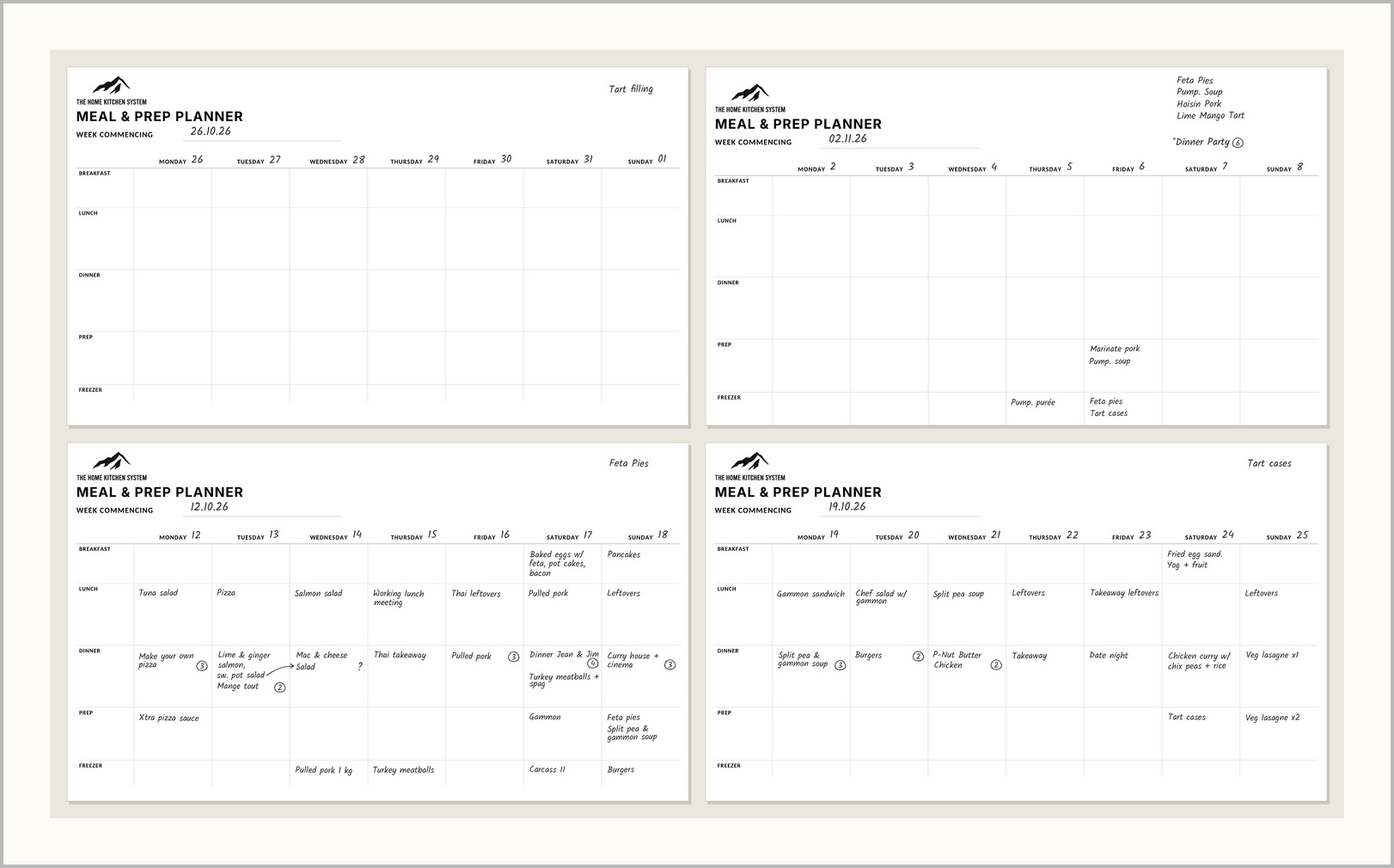
You’ll notice the following week looks sparse. That’s because I plan Wednesday to Wednesday, with my top-up shop on Saturday. I haven’t finished that week’s plan, but there’s enough on it for my focused shop — and that gives me a few days to add the detail, and to make a start on the week after.
Take a look at your calendar for the week you’re planning. What are the main obligations — yours and everybody else’s? A dinner date, drinks with friends, a Pilates class that finishes at seven every Wednesday night, pottery on alternate Saturday mornings. Does your daughter or son have football practice in the evenings? A study group, skating? What are your partner’s movements? Look at it the way a restaurant looks at its bookings: every booking is a number of “covers” — the trade word for the people being fed — and the kitchen plans around how many it’s feeding and when. At home it’s no different — who’s in, who’s out, who’s eating late, and who’s grabbing something on the way to practice.
Your menu is planned around your week, not the other way round. The house calendar already holds everybody’s comings and goings, so there is no need to put that information into the Meal & Prep Planner.
I make a note of how many people will be eating dinner — if I’m uncertain then I put a question mark. I generally leave breakfasts empty in the week — whoever comes into the kitchen first makes the coffee and sets out the cereal, bread, fruit, cheese, yoghurt, whatever, because in my house breakfast tends to be a grab and go affair. Plan lunches accordingly — who takes a packed lunch daily, and who prepares it.
When planning, I want to use up whatever is in the fridge first. Those pork chops and the cottage cheese inching towards their use-by date, the sandwich meat, the bacon, the watermelon, the peaches, whatever it happens to be.
Now look through your Freezer List and allocate any full meals sitting in the freezer.
Wednesday is a freezer night, definitely — Pilates finishes at seven. And drinks with friends on Friday almost always run later than planned, so that night is either a takeaway or something already made.
How much of what you need for the week is already sitting in the larder? Some people keep all their tinned and jarred foods in there, along with anything they’ve canned themselves. Are you using the pizza sauce you canned last autumn, or the apple sauce? Do you already have a tin of black olives for the tapenade, or a jar of pesto? You’ll want to use these items up — why are they there, if not to be used?
By now the planner holds everything you already know: the meals shaped by your calendar, the ones sorted from the fridge and freezer, and the takeaway you’ve planned. For anything coming out of the freezer, use the freezer row as your reminder to take it out two days ahead, so it can defrost safely in the fridge. What’s left are the open slots, and this is where honesty comes in.
Start with breakfast. In my house it’s grab and go during the week, but that won’t be true for everyone — if you have young children, or your household likes to sit down together in the morning, breakfast needs planning like any other meal. Weekends are often different too: a slow breakfast or a late brunch may be the one meal of the week when everybody is home, so give it a place on the planner.
Then lunch. Who’s at home, who’s working from home, and who needs a packed lunch? Last night’s leftovers often make the best lunch of all, so if there’s a lasagne on Monday, Tuesday’s lunch may already be sorted. And if lunches are made the night before, that counts as getting ahead, so note it on the prep row and the time is accounted for. At the weekend, lunch may well be the main meal of the day — a long Sunday lunch with everyone around the table — in which case the evening is the one to keep light.
Then dinner. Look at each open evening and ask yourself how much time you will realistically have — not how much you’d like to have. Tuesday might give you an hour to cook something from scratch; Thursday might only give you 20 minutes, which makes it a pasta night — or that vegetable lasagne in the freezer — not a new-recipe night. And on some evenings, there’s room to get ahead as well — cooking two batches of bolognese and putting one in the freezer, which is your Tuesday night in the bank three weeks later, or preparing something for your sister’s visit next month. And if you have a lot of pre-prep to get through, plan a freezer meal for that evening, so the time you’d have spent cooking dinner goes into the prep instead. That goes on the prep row, which is only for getting ahead: if I have roast chicken on the menu, I don’t write it on the prep row for the same day, because I know I’m cooking roast chicken that day.
I always plan a leftover meal too, lunch or dinner, so nothing goes to waste. Just the other day, we had a leftover dinner we called an indoor picnic: chicken wings, hummus, mixed bean salad, a few cold slices of pizza and a couple of pieces of pineapple cake, left over from a recipe I’d tested in the week. And if there turn out to be no leftovers, there’s always the Back-Up Plan.
If a recipe you want to try needs time, give it a slot that has time. This planner is for your benefit, so there’s no prize for filling it with ambitions you won’t keep. Be honest with yourself, and plan a week you will actually follow.
Once it’s complete, keep it where you’ll see it. My clipboard lives with my notebook on a corner of the counter that isn’t used for prep, and I refer to both every day. In a busy household, the week’s menu might go on the fridge, or someone takes a photo and sends it to the family group chat — then nobody needs to ask what’s for dinner.
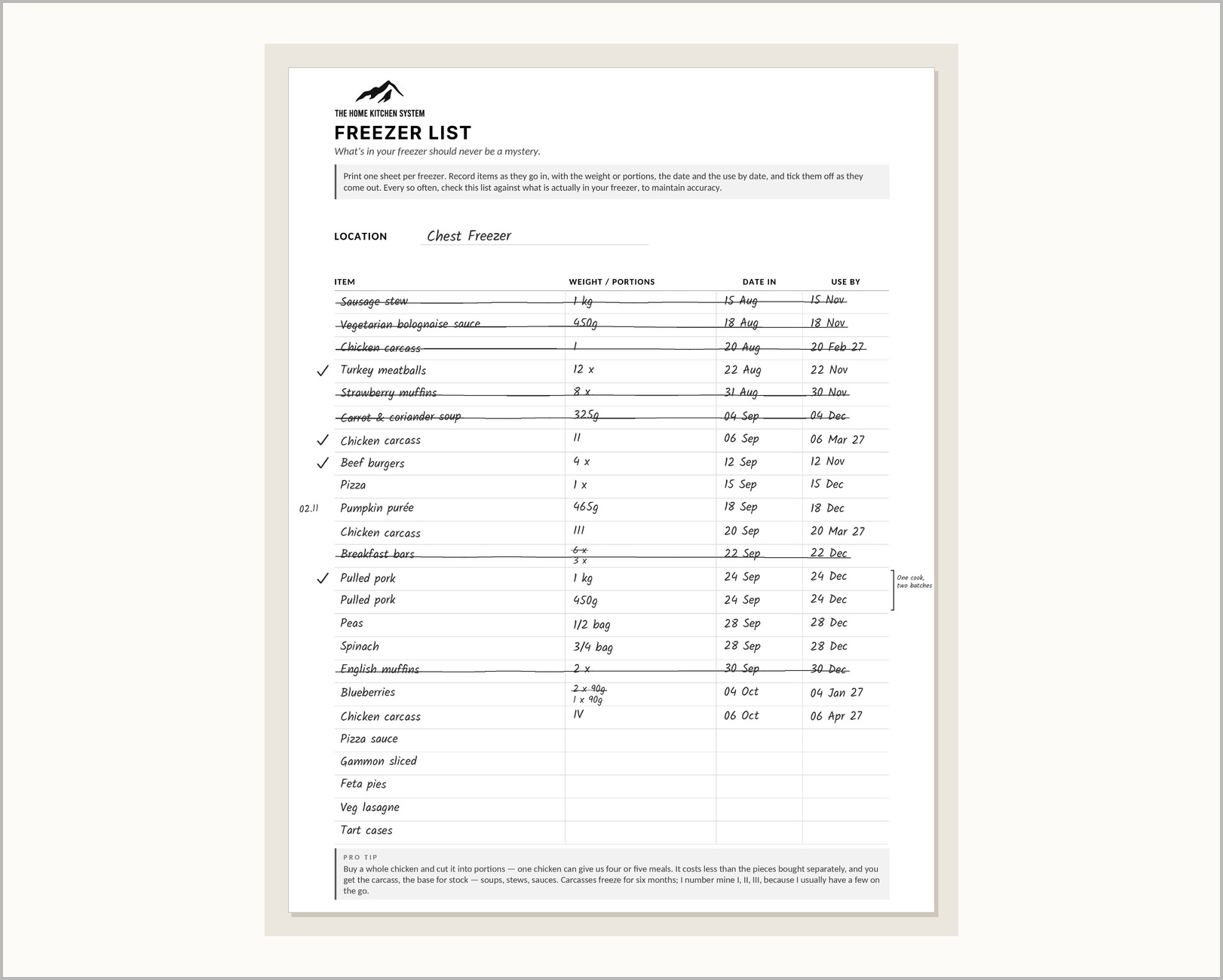
You’ll notice on the Freezer List example above that I’ve written down things I plan on prepping. I haven’t officially added them to the Freezer List yet, though, because life can get in the way; they go on once they’re in a container and labelled. Likewise, I’ve put ticks next to the items I plan on using, but I haven’t crossed them off yet — if plans change, they’d be crossed off the list and still sitting in the freezer. So those little notes and ticks are really just reminders for me. That’s how I work my planner, but there’s no right or wrong way to do this — you’ll work yours however suits you.
I keep a kitchen notebook. It is supposed to live in a drawer, but it spends its time on the counter next to my clipboard, because I use them both every day. I write down everything I cook: the date, the name of the dish, the ingredients and the quantities for the number of people eating — rather than relying on a phone screen that switches off halfway through. If I’ve added something to a recipe or left something out, I note that too, and I do the same when I’m creating recipes of my own. That way I have a record, and when it comes to the shopping list, I can see at a glance how much of any one ingredient I need. If we love a dish and want it again, the quantities are already there, and it’s easy to work them up or down for however many we’re feeding next time.
In my catering kitchen, we wrote every main course for 100 portions and every cake for 60, and scaled up from there — a cake recipe has to be written to fit the tin it’s baked in. These pages are from my old notebooks: on the left, one cake recipe made two ways — a straight courgette cake, or beetroot and orange — worked up for three cakes and then three and a half, or 210 portions. I could see in seconds that we needed 32 eggs and nearly 4 kilos (8¾ lb) of flour. Nobody had to work a recipe out from scratch every time it came up on the menu; we worked it out once, wrote it down, and kept adding notes. At home, my notebook does the same job.
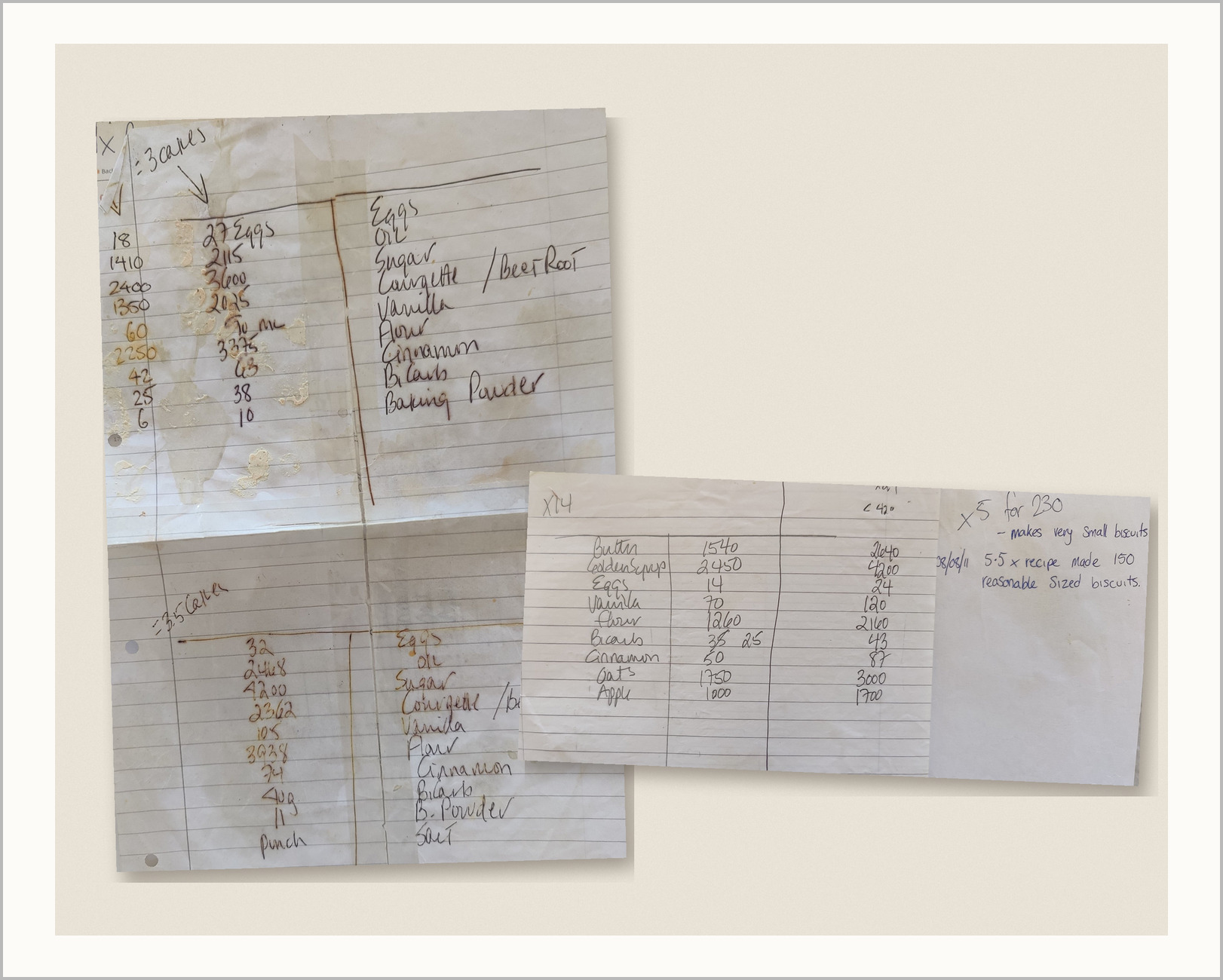
The more notes I make, the more I refer back to them, and I now have so many recipes that I generally fill in my Meal & Prep Planner straight from the notebook, because everything I need is already there. Hang on to your old planners, too. Keep the weeks you enjoyed at the back of the clipboard, and between them and your notebook, you’ll build up your own collection of menus and recipes — no more rummaging around every time you’re looking for something. Before long you’ll be able to pick and choose from the weeks you liked, leaving a day or two blank for something new, or a recipe you want to try. I have enough now to go eight weeks without a repeat meal. And once you’re reusing weeks like this, planning your pre-prep becomes easy: the weeks ahead are already filled in, so you can see exactly what’s coming up and plan for it. That’s what monthly rolling menus give you — weeks of meals already planned, ready to pick up and use again.
What are the things you eat every week regardless of the menu? Milk, butter, cheese, cereal, bread — and condiments, like ketchup, mustard and Tabasco. Those are your standing orders, and it is rare that the quantity changes much. They still have to be bought; they just don’t need planning.
The same goes for the things you always want to have to hand — guacamole with some tortilla chips, hummus with carrots, baked beans for any time, fruit, salad items. I have my own favourites, and they almost always include a pot of coleslaw and a mixed bean salad from the deli counter. They are not on any of my meal plans, and that is deliberate.
Plenty of planners give you a section for snacks. I don’t think snacks need planning — to my mind, they’re standing orders too. When I fancy some peanut butter on crackers, I don’t need to plan it, and I know for a fact I’ll want some olives and maybe some hummus later on, when I’m unwinding after a busy day. Having them in the house doesn’t change how we eat — it simply means knowing what you like to have to hand, and making sure it’s there.
If you are on a strict diet — or any prescribed diet — your standing orders will be completely different to my example, but for me, it’s important to keep them on the lists as it keeps us organised.
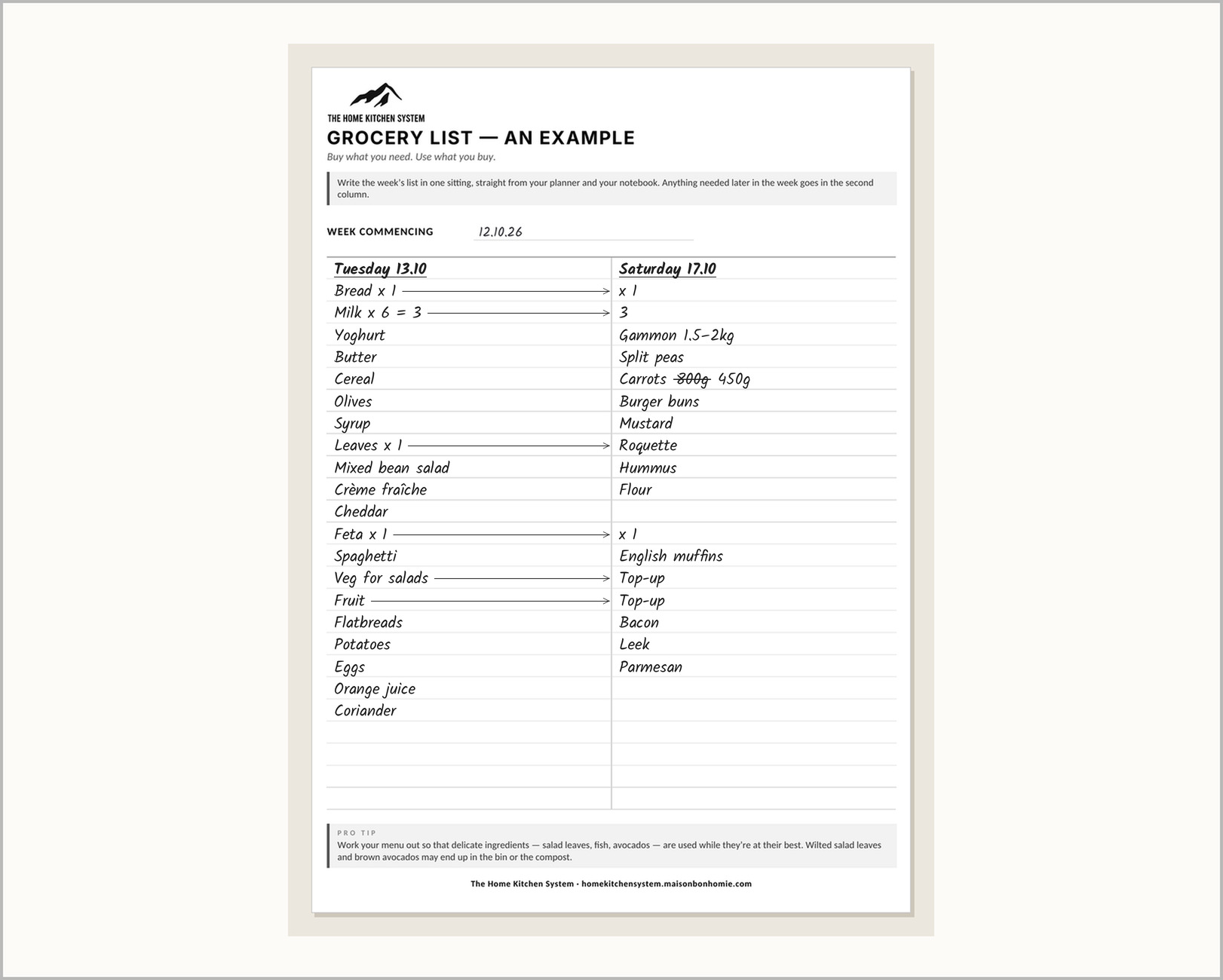
This is not about me telling you how to write a shopping list — it’s about sharing how I work out the details. In a commercial kitchen we are always watching our costs: every time we spend money to earn money, it has to fit into our overall budget. The same concept works at home. We have to eat, so we buy food, and so as not to over-buy, we have a shopping list — and I work mine at home just the same as I did professionally. Only, instead of working my lists around the days the suppliers deliver, I create them around the days I want to do the big shop.
It is unrealistic to think you will do one big shop for the week and that is that, because in real life it does not happen that way. Ingredients deteriorate. Milk spoils, fish has a very short life, lettuce wilts, avocados go off in days.
So we do what restaurants do. We plan our orders around the menu and around the sensitivity of the ingredients. That is why I always work my menu out a full week ahead at a minimum — so I can write my grocery lists in one sitting, which saves time, and to my mind, time is money.
What day would you like to do your big shop?
Lining my planners up Wednesday to Wednesday, I do two focused shops a week — the big shop on Tuesday, and a second top-up shop on Friday or Saturday afternoon, depending on my schedule.
I write down on one long list the ingredients required for the week, along with my standing orders. I consult my notebook for quantities required for what I’m preparing; let’s say my menu requires the use of tinned tomatoes more than once — I put the total quantity required minus any I may already have in my larder. I do that because I write all the requirements in one sitting, then I consult the Freezer List and check the pantry and fridge for what’s in-house, and then adjust the requirements. This is a habit left over from the catering kitchen, because it keeps me from over-buying ingredients. I use my own shorthand. I always have salad bits, fruit & veg on my standing orders, so I don’t list those separately. The exception is something specific, like pomegranate seeds or mangetout — items for a particular recipe.
Drawing a line down the centre of the page, I then move any items that are required later in the week onto the Saturday column.
I’ve seen other planners that ask you to schedule in your time — 10 minutes between 7 and 8.15am and 30 minutes over there for prep, getting ahead for tonight’s dinner — and I understand the reasoning behind that. Mainly, it shows that today’s menu, planned well, doesn’t have to take up loads of time, and it forces you to think about how you actually use your time. But life does not work that way. Don’t sit there and tell yourself that you will wake at six every weekday, spend exactly 15 minutes at 6.45 chopping the vegetables for tonight’s curry, then dry your hair, pack everybody’s lunches and get on the train to go to the office. This may work for a few days or weeks, but inevitably, something will come up, life will get in the way and you won’t stick to such a rigid plan.
Recently, I had been thinking about this very same issue, and how I kept telling anybody who would listen, particularly myself, that I had absolutely no spare time. The very next morning, I caught myself sitting in the bedroom for 45 minutes with a cup of coffee, under the delusional justification that I was just checking my emails [which always somehow end up with a link to Facebook or Instagram]. The idea of no spare time was just another story I told myself. So, the next morning, I poured my coffee, spent 30 minutes cooking off the mince and the onion for a chilli later on, then checked my emails — and by 7.30 I was ready to go for a morning walk, rather than having just finished my emails. I didn’t write this on the planner; I found the time and did the job when it suited me, and that is how I work my planner — flexibly. The truth is, most of us do have spare time; we just end up spending it on Facebook rather than on something useful.
When we lived in London we were out constantly — meeting friends for dinner, the theatre, drinks with colleagues — and we still prepped. If we knew we would be home late, a full meal was never going to happen, so there might be a pasta salad and some grilled chicken pencilled into the planner for lunches, which we used flexibly — ready for when we got home. Or we would hit the back-ups, or use up the leftovers.
And if the plan moves — say you went out for dinner on the night the chicken legs were meant to happen — then the next morning, while you are having your coffee, pop those legs in the oven before you get in the shower. Forty-five minutes later, voilà: that is lunch tomorrow, or, with some coleslaw, the dinner that covers the night you are back late.
So be flexible. Schedule your pre-prep on the planner, and if you find yourself with a spare 20 minutes in the morning, go ahead and chop the vegetables for this evening — that’s daily prep, and it never needs to go on the planner. Then give yourself some spare Facebook time later in the day, or go for a run, or jump on the exercise bike whilst that chilli is cooking. Either way, be kind to yourself, and leave room for life’s eventualities. Plan yourself too rigidly and there’s no time to enjoy the unexpected — the phone call that turns into an hour catching up with an old friend. If you’d scheduled that hour, you might well have spent the rest of the day trying to find an extra hour somewhere to catch up with yourself.
And, just for good measure, I’ll share one last illustration. In a professional kitchen, one must run a continuous menu cycle — we can’t not plan for Wednesday lunch because we don’t feel like it, so printing a couple of weeks’ worth of Meal & Prep Planners keeps the momentum going. Going back to working my planners backwards, this is how it works in practice:
You’ve invited your boss and her partner over for dinner in a few weeks’ time. You want to serve those gorgeous dessert tarts you bookmarked ages ago and have been waiting for an excuse to make. Back in the autumn, when the pumpkins were in season, you prepped and puréed a batch. Hmm — what can you do with that now? Aha! For the boss’s dinner, you can start with a spiced pumpkin soup, then that divine slow-cooked pork recipe for the main, and the lime and mango tarts for dessert. Three weeks before, you could prep the soup and freeze it in the quantity you need for the party; you could make six to eight tart cases a month before and freeze them and prepare the filling the week before. Ooh — your mind is racing. What about some nibbles with drinks? You saw a delicious-looking recipe recently for those nibbly little feta pies that freeze ever so wonderfully. Bingo — they go on your prep list a fortnight before the party. Pretty soon you realise you’re so organised that getting stressed out simply doesn’t happen. You can actually participate in your own dinner party — what a novel concept! None of that was extra work. It was the same amount of prep, done at a moment that suited you. Below are my planners, showing how it actually worked.
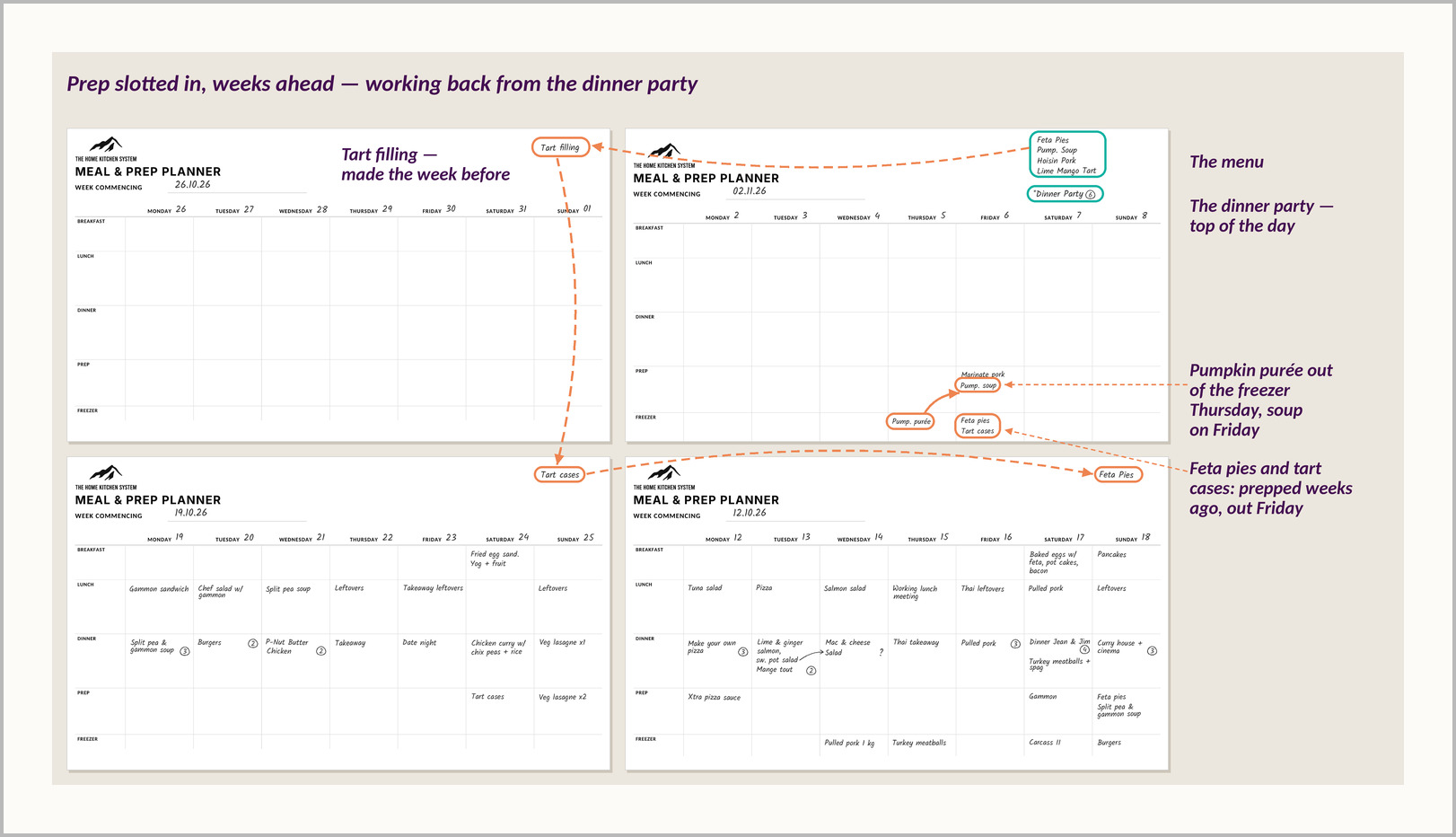
That’s your menu. Now let’s go “back of house”, to everything that makes it work — rotating your stock, the temperatures and the labelling. I don’t expect anyone to start memorising all of this; there’s no need, it will be here whenever you want to refer back to it. But being aware of safe fridge and freezer temperatures is good practice, and in any kitchen — yours or a restaurant’s — good practice is always good practice.
Organise once. Maintain daily. Waste nothing.
Larder, pantry — same thing.
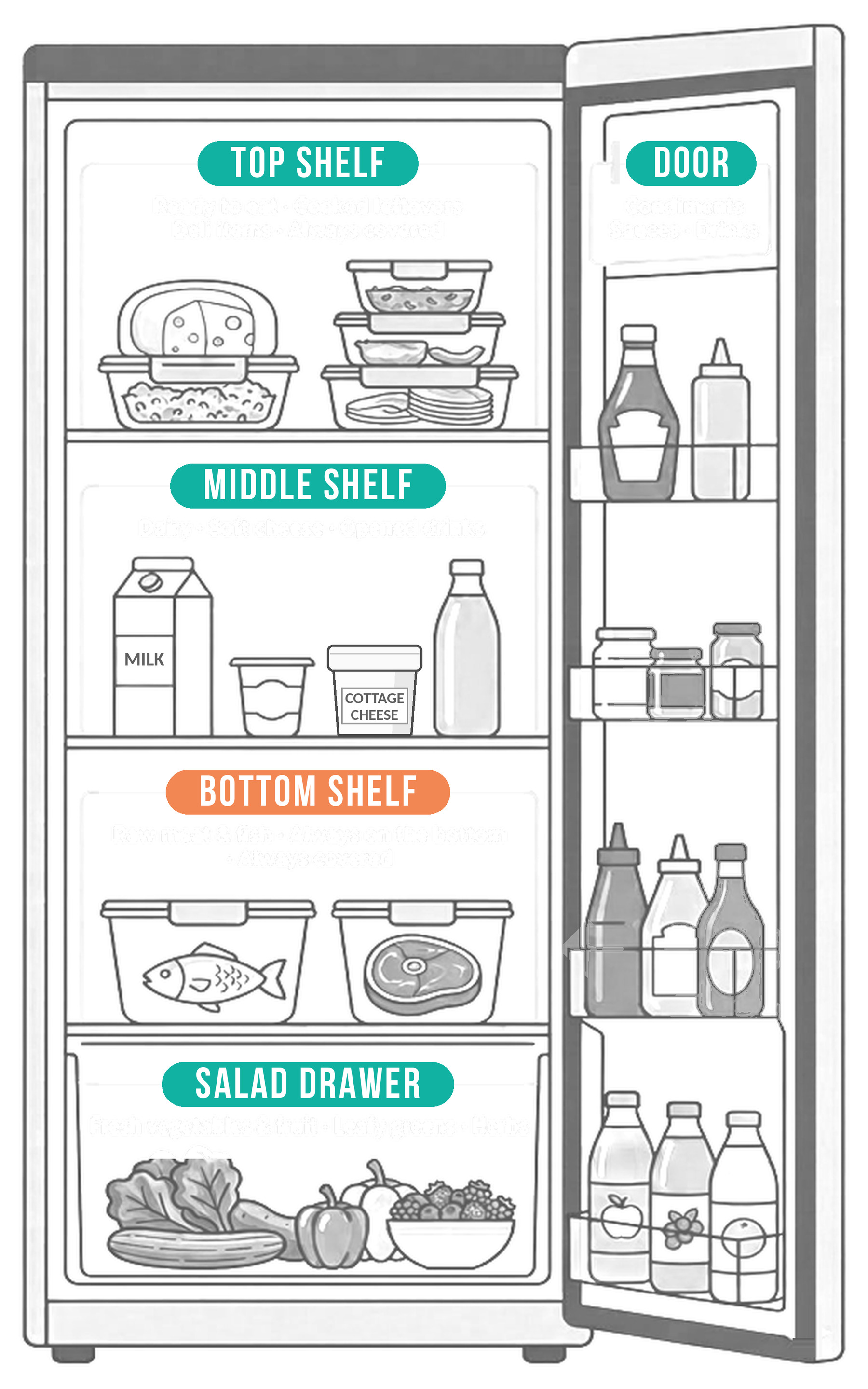
Apply these zones to whatever fridge you have. The principles hold regardless of size or model.
| Top shelf | Ready-to-eat food, cooked leftovers, deli items. Always covered or sealed. |
|---|---|
| Middle shelf | Dairy, soft cheese, anything opened that needs to stay properly cold. The back of the shelf is the coldest spot in the fridge — that is where your milk belongs. |
| Bottom shelf | Raw meat and fish. Always the lowest shelf, always covered or sealed. Never above ready-to-eat food — if raw juices drip, they must not drip onto other foods. |
| Salad drawer | Fresh vegetables and fruit, leafy greens, fresh herbs, pre-packaged cut produce. |
| Door | Condiments, sauces, sealed bottles. The door is the warmest part of the fridge and swings in temperature every time you open it — which is why, despite the moulded milk shelf most fridges come with, milk should never live there. |
| Labelling | Label everything as you store it. |
| FIFO | First In, First Out. New items to the back, older items to the front. Oldest used first. |
|---|---|
| 3 months | The standard home freezing guideline. |
| Portion before freezing | Freeze in portions you will actually use. |
| Refreezing — raw | Once raw meat, fish or poultry has thawed, it does not go back into the freezer. Treat it as fresh: cook it within three days of taking it out of the freezer. |
| Refreezing — cooked | Food that was frozen, thawed, then turned into a cooked dish — mince into a bolognese, say — can be frozen once as that dish. One freeze only from that point. |
| Fish warning | Fish bought frozen goes straight into the freezer when you get it home, or into the fridge to use later on. Never freeze fish or seafood sold as fresh — much of the chilled fish on a supermarket counter or at a fishmonger has already been frozen at sea, so buy it for the day you’ll cook it. One exception, and this is my own practice rather than an official guideline: smoked fish cooked into a dish — a smoked haddock stew, say — can go in the freezer, for up to a month. A piece of cooked fish on its own, I wouldn’t freeze. |
| Thawing | Always thaw in the fridge — plan ahead, large items need 24–48 hours. Once it’s out of the freezer, it keeps for three days in the fridge — count from the day you took it out. For faster thawing, submerge in a sealed bag in cold water, changing the water every 30 minutes, and cook immediately afterwards. Never thaw at room temperature, and never in the microwave. Ever. |
| Labelling | Label everything as you store it. Nothing unlabelled goes into the freezer. |
| Freezer List | Use the Freezer List to record what is actually in your freezer. |
| FIFO | New stock always goes behind existing stock. Oldest at the front, always used first. |
|---|---|
| Decant and label | Decant dry goods into airtight containers and keep the packet date. |
| Opened packets | Once opened, reseal properly or decant immediately. |
| Jars & tins | Unopened jars and tins follow the packet expiry. Observe FIFO. No labelling needed. |
| Visibility | Store items so labels face forward, and use the Stock List to keep a record. Labels only help with what you can see. |
| Eggs | Room temperature, away from direct sunlight.** |
|---|---|
| Bread | Room temperature in a bread bin or wrapped. Refrigeration dries bread out. |
| Tomatoes | Always room temperature. The fridge destroys the flavour. |
Storage times for everyday foods.
Organised by where the food lives, like your Fridge & Larder Rotation Guide.
| Item | Chilled storage |
|---|---|
| Meat from butcher | Follow your butcher’s guidance, or 3 days maximum |
| Supermarket meat | Follow the packet |
| Mince from butcher | Follow your butcher’s guidance, or 2 days maximum |
| Supermarket mince | Follow the packet |
| Whole chicken & poultry | 2 days |
| Fresh fish, seafood & shellfish | Same day — buy and eat, don’t store |
| Smoked fish | Follow the packet |
| Item | Chilled storage |
|---|---|
| Milk | Follow the label |
| Cream | Follow the label |
| Butter (fridge) | Follow the packet, up to 3 months |
| Hard cheese | 3–4 weeks, wrapped in wax paper or cheese wrap — not cling film (plastic wrap) |
| Soft cheese | Follow the label; once opened, keep covered |
| Item | Storage | Notes |
|---|---|---|
| All cooked food & leftovers | 3 days | |
| Cooked rice | 1 day max | Cool fast; into the fridge within an hour of cooking. Reheat once only. |
| Cooked pasta | 2 days | |
| Cooked beans & pulses | 1 day max | High-risk. Cool fast; into the fridge within an hour of cooking. |
| Soups & homemade sauces | 3 days |
Everything that goes into the fridge is covered or sealed, and carries a label.
If you’ve made a pot of bolognese to save for dinner tomorrow, or for your freezer library, get it into the fridge or freezer within two hours — sooner in a warm kitchen. Cool it fast in shallow containers; high-risk foods like rice and beans go in within the hour.
| Item | Use by |
|---|---|
| Beef, lamb, pork | 3 months |
| Chicken & poultry | 3 months |
| Bones & carcasses (for stock) | 6 months |
| Mince | 2 months |
| Shop-bought frozen food (fish, seafood, vegetables, fruit) | Follow the packet |
| Cooked dishes | 3 months |
| Smoked fish dishes — a stew, say | 1 month |
| Bread | 1 month |
| Pastry | 2 months |
| Cakes, muffins & batters | 3 months |
| Item | Storage time | Notes |
|---|---|---|
| Dried pasta & rice | 1 year | Airtight* |
| Dried beans & pulses | 1 year | Airtight* |
| Flour | 6 months opened | Airtight* |
| Sugar | Indefinite | Store dry and airtight |
| Tinned goods | Follow the label | Once opened, decant, label and refrigerate; use within 3 days |
| Dried herbs & spices | Follow the expiry date | Replace if the smell or colour has faded |
| Oils | Follow the label | Away from heat and direct sunlight |
| Condiments | Follow the label | Refrigerate once opened |
| Jarred & bottled sauces | Follow the label | Refrigerate once opened |
| Pouched & carton sauces | Follow the label | Once opened, decant, label and refrigerate |
* If you decant, cut the expiry date off the packet and drop it into the container.
| Item | Storage |
|---|---|
| Eggs (supermarket) | Follow the label |
| Eggs (farm or market) | Up to 3 weeks in a cool place, out of direct sunlight |
| Butter (room temperature) | Salted only. Salt is a natural curing agent and slows the deterioration, so salted butter keeps well in a covered dish, out of direct sunlight. Unsalted butter goes off faster and belongs in the fridge. When the kitchen is warm, it all goes back in the fridge. |
| Bread | Bread bin or wrapped; the fridge dries it out |
| Tomatoes | Room temperature; the fridge kills the flavour |
Know what you have. Know when to use it. Waste nothing.

Fresh fish, seafood & shellfish. Buy and eat.
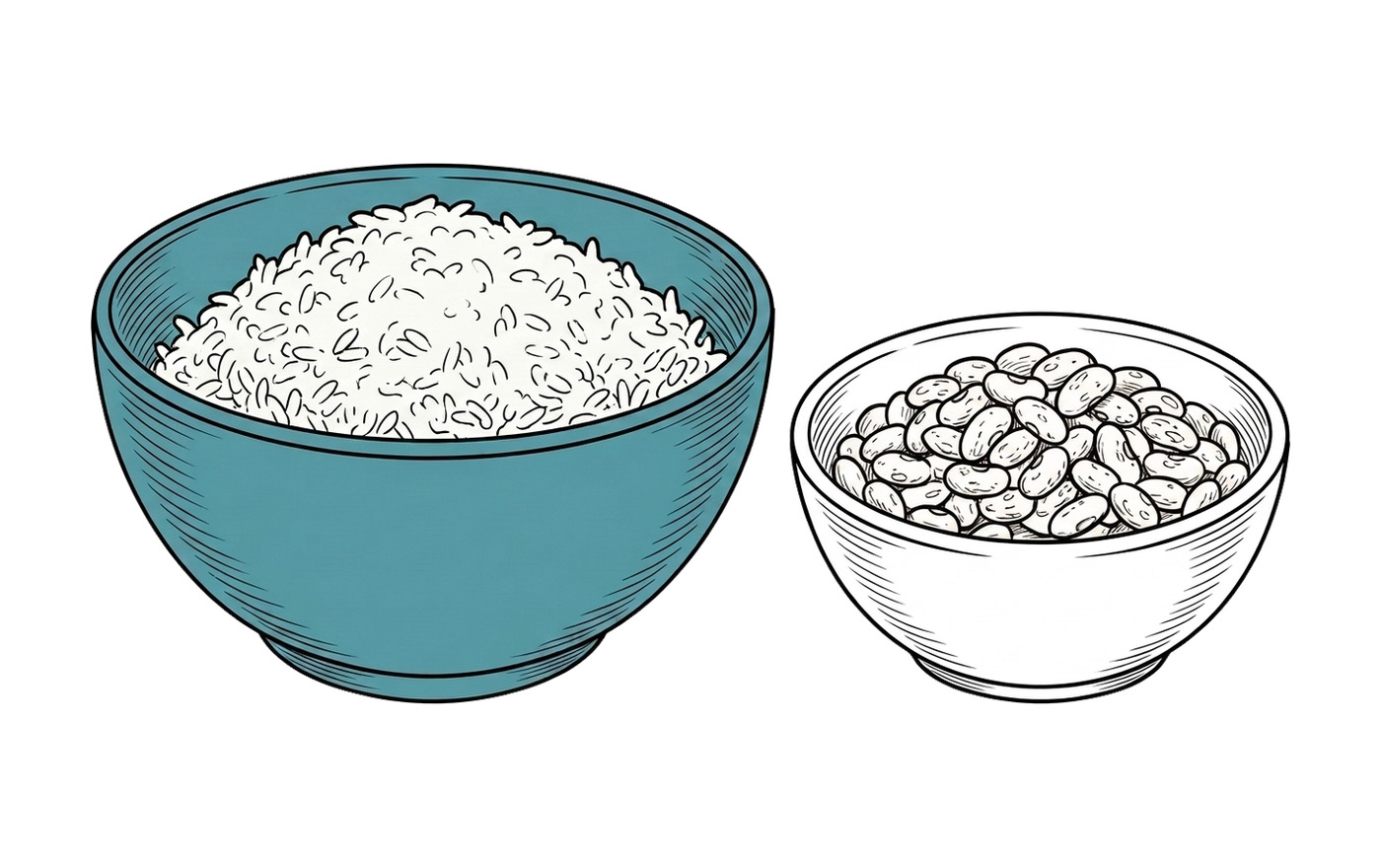
Cooked rice & beans. High-risk: cool fast, fridge within the hour.
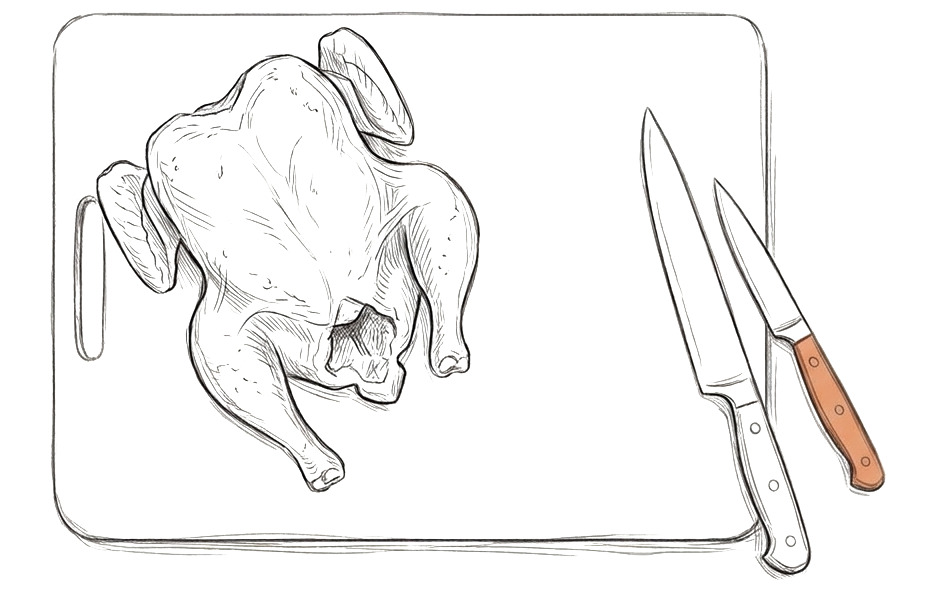
Raw chicken & mince. Cooked pasta.
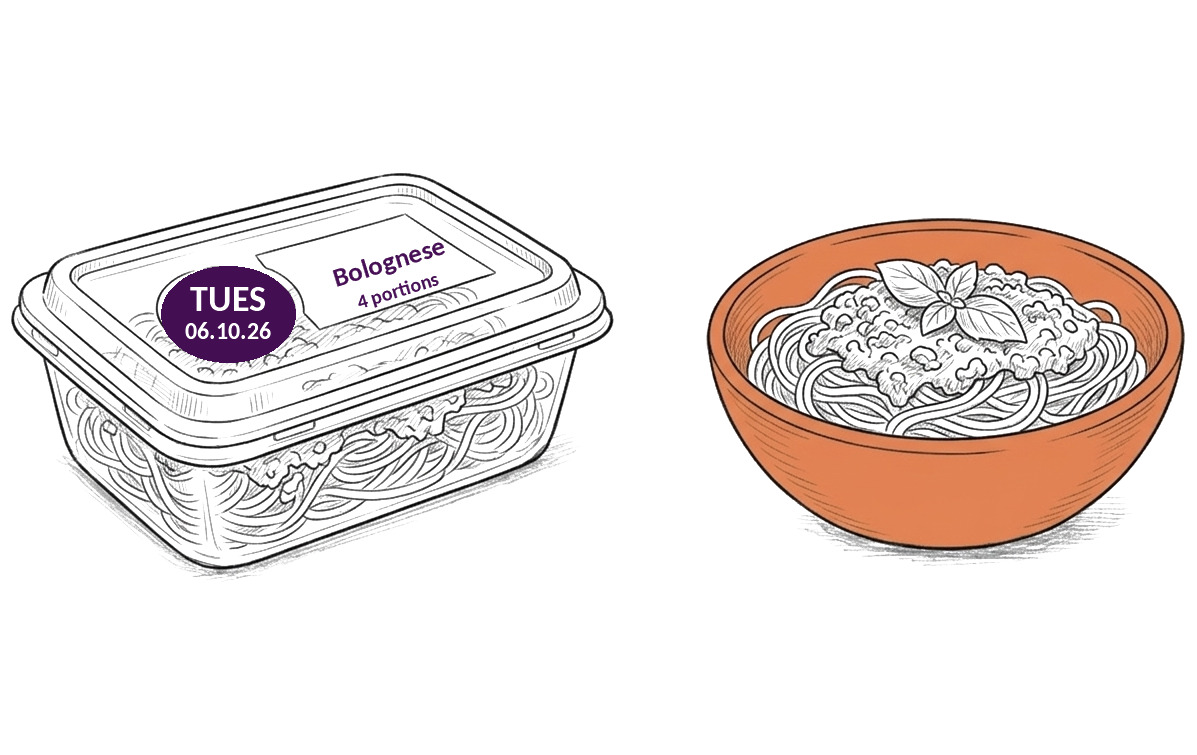
Cooked food, leftovers, and anything out of the freezer.
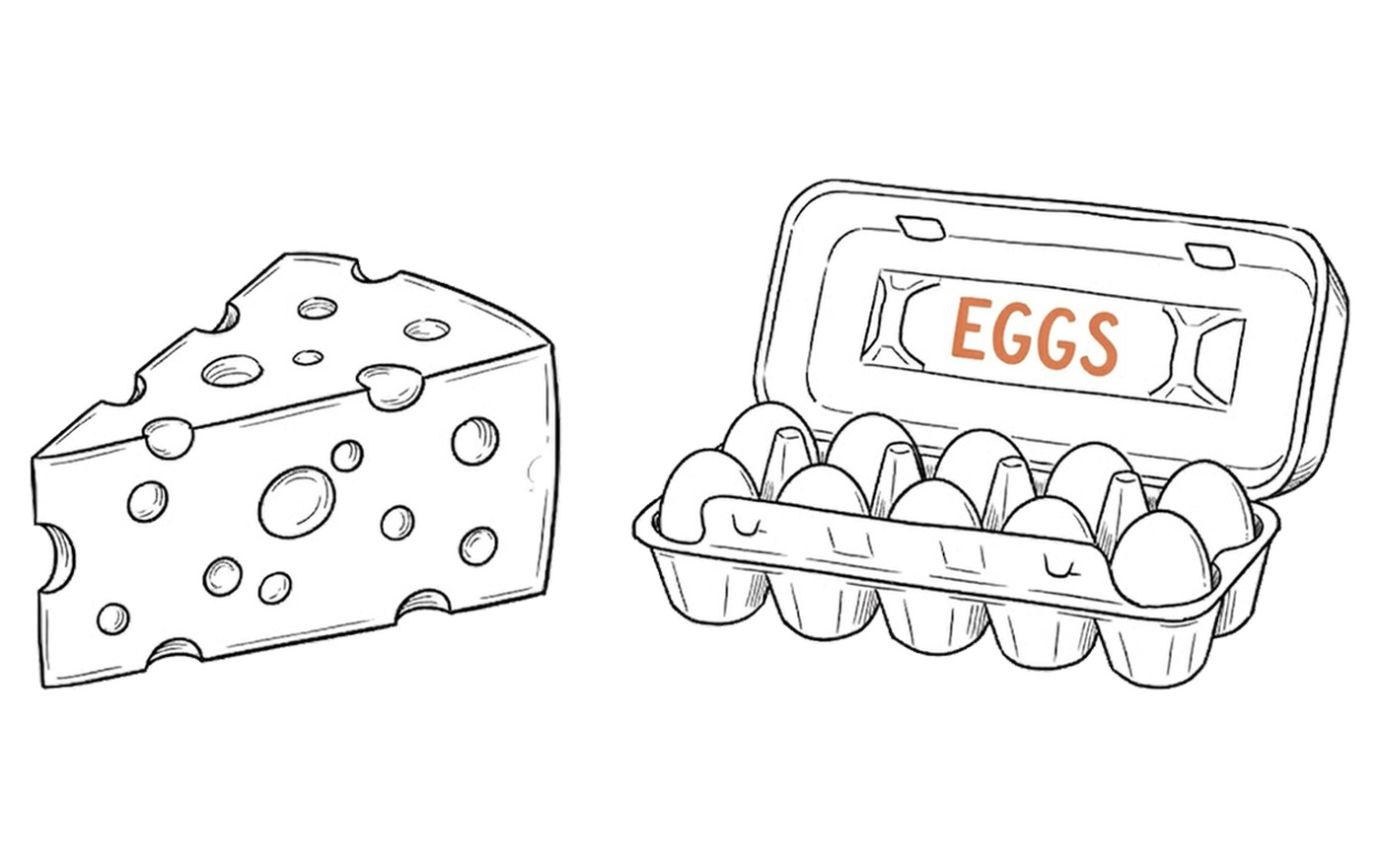
Eggs up to 3 weeks. Hard cheese 3–4 weeks, wrapped.
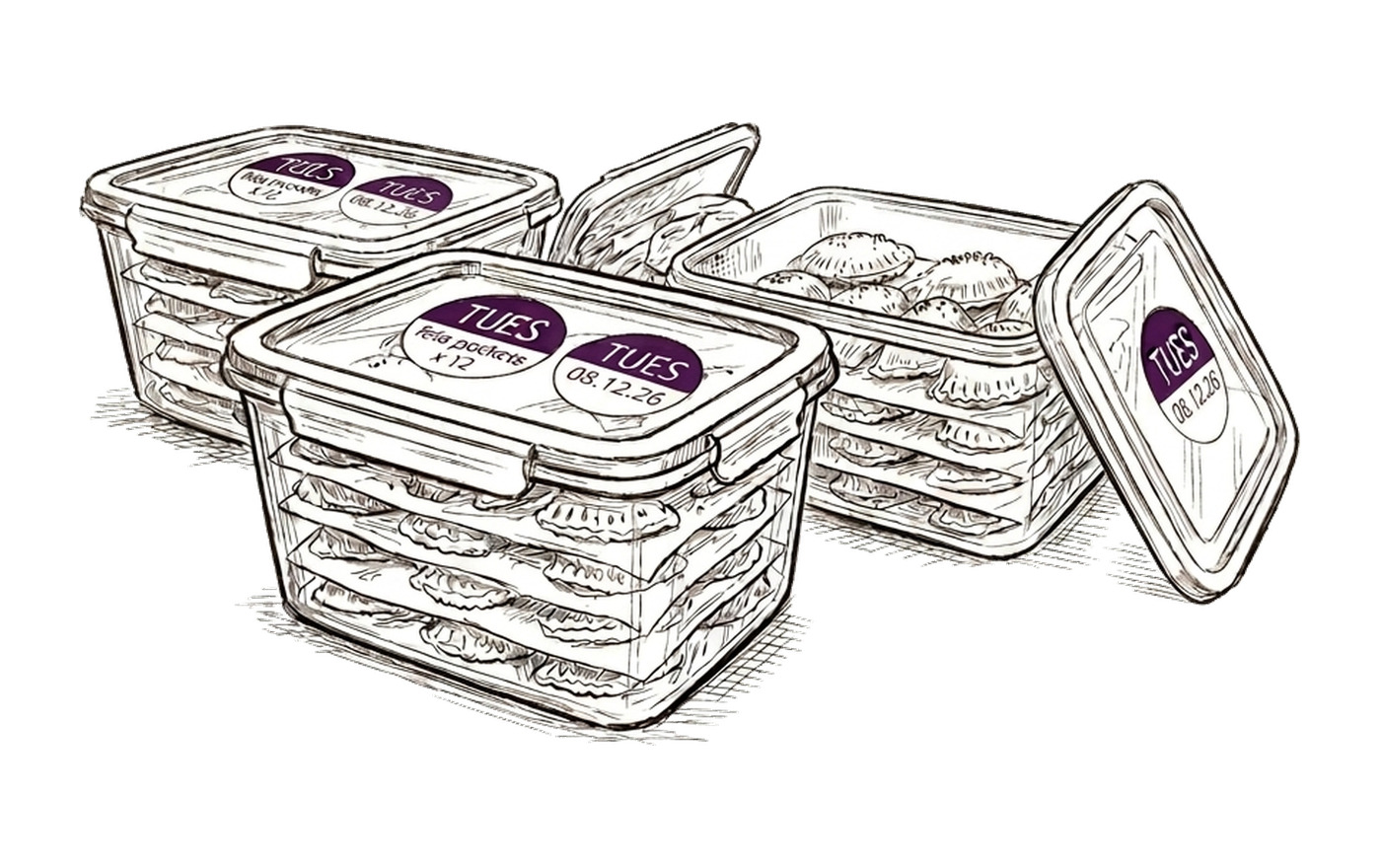
The freezer. Always labelled.
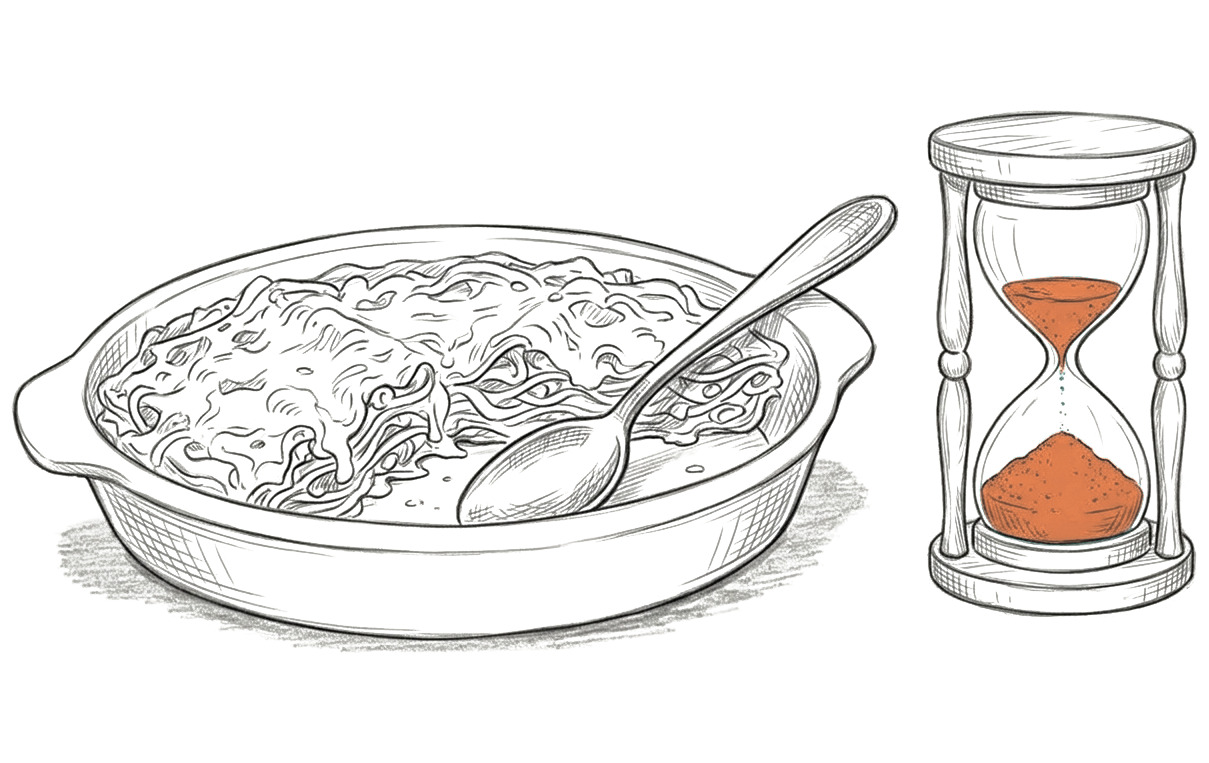
Cooked food left out: two hours, or one hour on a hot day. Then bin it.
Butcher vs supermarket, dairy, frozen and dry goods — every time is in Food Storage Times — In Detail.
Know what it is. Know when it’s safe. No guessing, ever.
FIFO — First In, First Out — only works if you can actually tell what’s in a container and when it stops being safe. A label is what turns “first in, first out” from a good intention into something you do without thinking. And because you can’t always tell when food is starting to spoil — often there’s no visible sign until it’s too late — the label is doing the job your senses cannot.
There are three situations here, and the first two are almost identical. Chilled and frozen food are labelled using day dots — small coloured adhesive labels marked with the days of the week, widely available from catering suppliers and online. Dry goods come already labelled; if you decant them into jars, you just need to keep the original label, not recreate it.
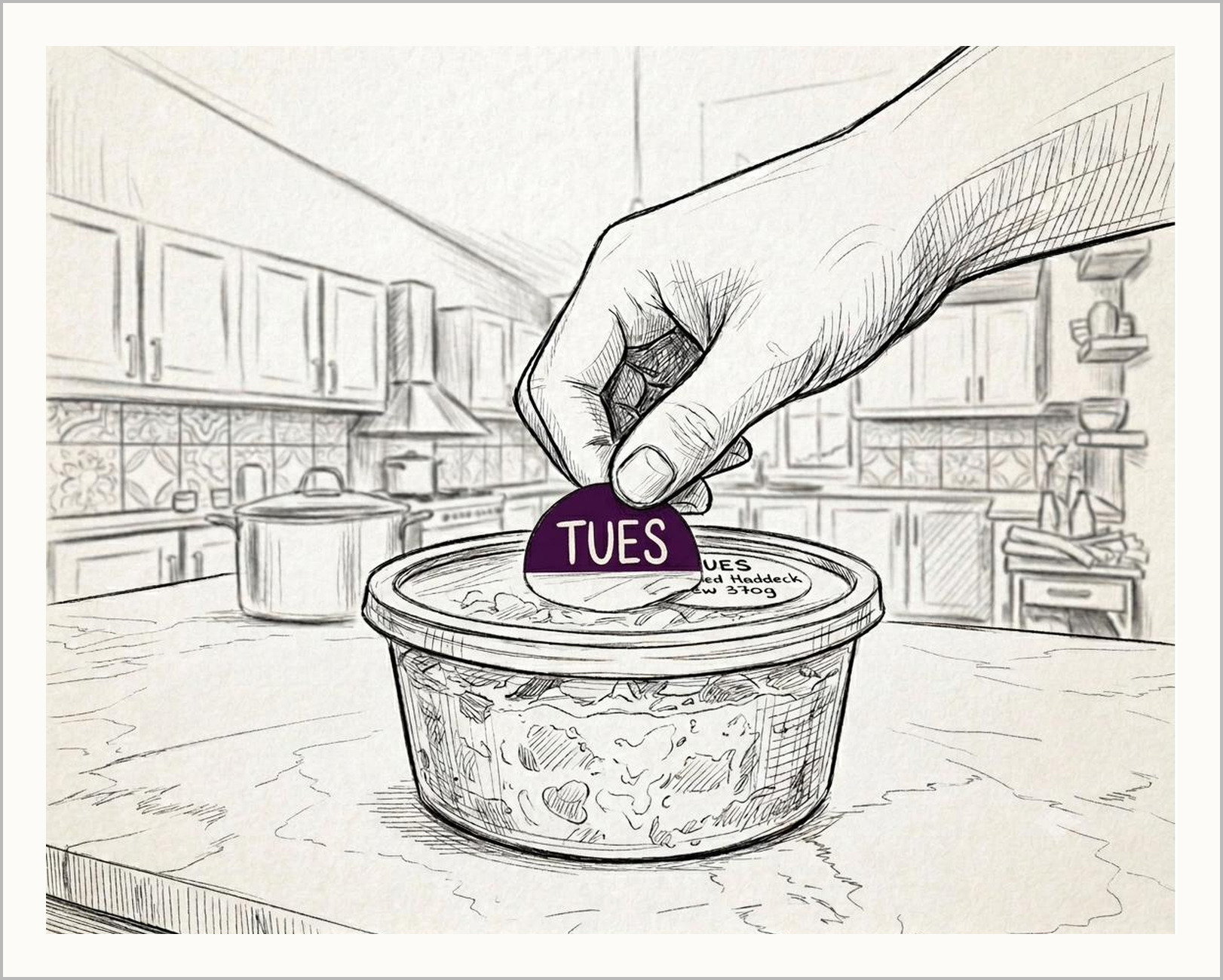
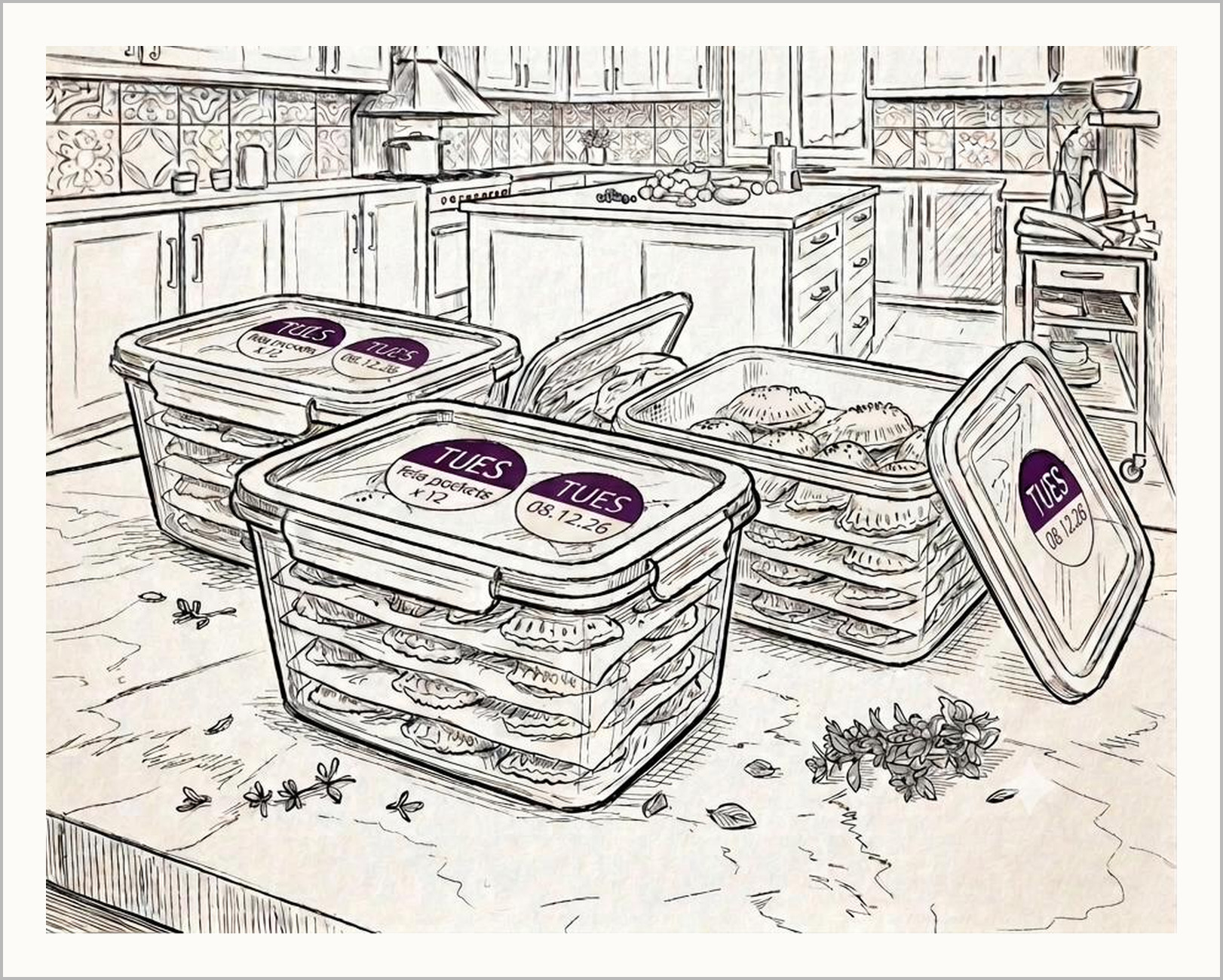
Rice, pasta, lentils, flour, sugar, dried herbs, nuts — anything you tip out of its packet and into a jar.
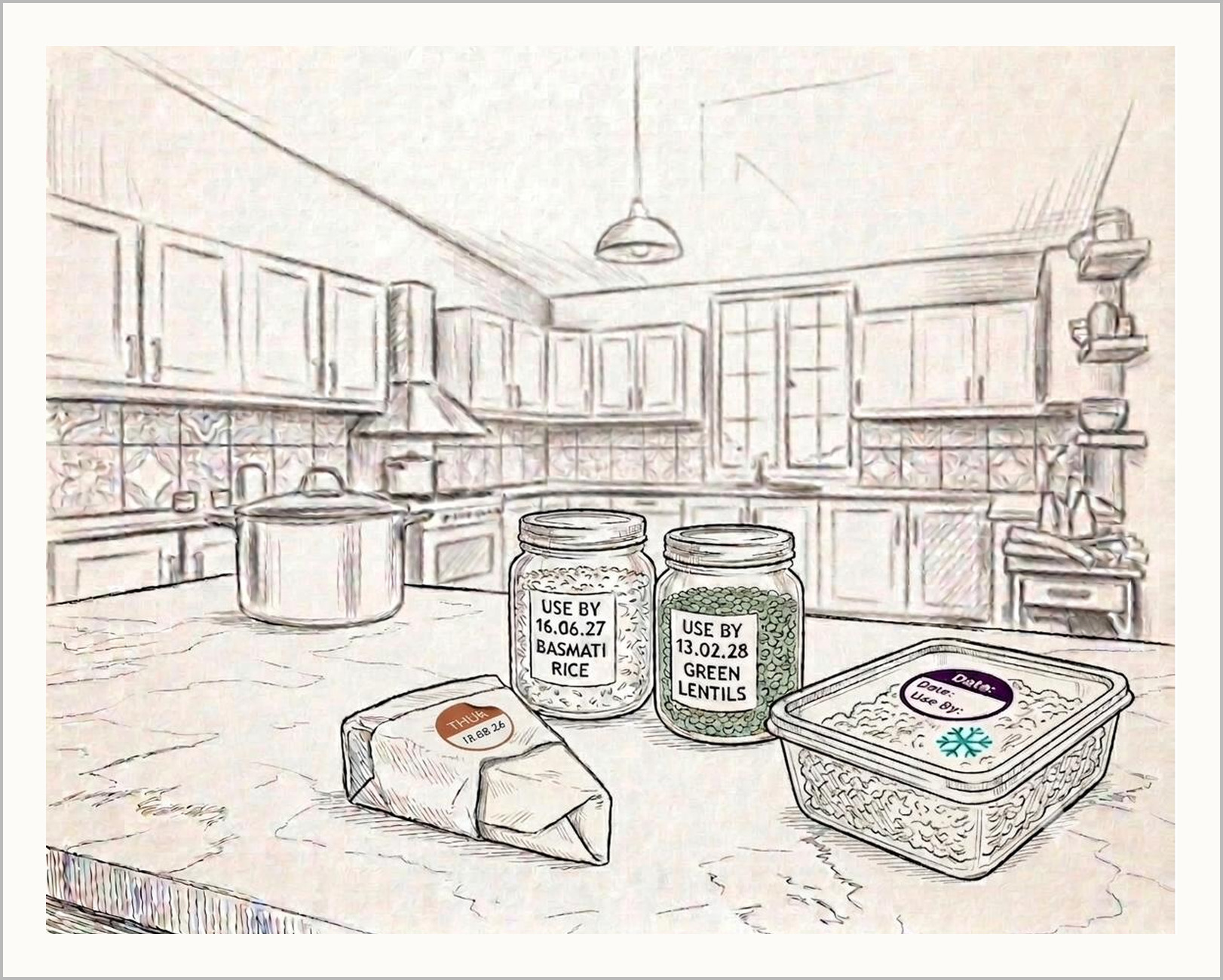
Learn this labelling system once and it carries the whole kitchen — the Fridge & Larder Rotation Guide and Food Storage Times — In Detail both point back here.
No guesswork. No risk.
Here is the truth about cooking temperatures — you cannot tell whether food is safely cooked by looking at it, timing it or cutting into it. It must reach a safe core temperature. A beautifully browned chicken can still be raw at the bone. A burger that looks done can still be dangerous in the middle. A vegetable lasagne can be bubbling at the edges yet barely warm at its centre. A temperature probe tells you in seconds what the temperature actually is, so you know straight away whether it’s cooked through or not.
Every professional kitchen uses one without exception. Once you start using one at home, you will wonder how you ever managed without it. It is not a gadget — it is the one thing that takes the guessing out of your kitchen and keeps your food safe. And meat-free is not risk-free — a meat-free bolognese reheated from the fridge still needs to be piping hot right through.
What you’ll need: a temperature probe (known in the US as a meat thermometer or instant-read thermometer) and probe wipes.
| Food | Temperature | Notes |
|---|---|---|
| Beef, lamb, pork — whole cuts | 63°C (145°F) | Rest after cooking |
| Beef, lamb, pork — mince | 71°C (160°F) | Right through — no resting |
| Chicken & poultry | 74°C (165°F) | Inner thigh, not the breast |
| Fish | 63°C (145°F) | At the thickest part |
| Reheated food | 74°C (165°F) | Throughout — no exceptions |
| Eggs | Fully set | For children, elderly & pregnant women |
| Food | Temperature | Notes |
|---|---|---|
| Cakes | 95–98°C (203–208°F) | Probe comes out clean |
| Bread | 90–95°C (194–203°F) | Fully baked through |
| Tarts & quiches | 70–75°C (158–167°F) | Custard set at centre |
Follow these steps every time, in this order:
A probe that reads even two degrees out is the difference between safe and unsafe food. Calibrate yours once a month — it takes two minutes and you will know it’s accurate.
How to calibrate: Fill a bowl with ice and add just enough cold water to fill the gaps between the ice. Insert the probe, stir gently and wait for the reading to stabilise. It should read 0°C (32°F).
If it doesn’t: replace it. You could work out the difference and adjust every reading you take for the rest of the probe’s life — but you won’t, and I’ve never met a chef who did. They cost very little. Replace it.
Keeping an eye on the temperature of your fridge and freezer isn’t just a good idea — it’s a game changer. If the electricity dropped out one night, or whilst you were away for the weekend, how would you know? Your food could spoil without the slightest warning.
The professional trick is good old-fashioned temperature checking, and it costs you nothing.
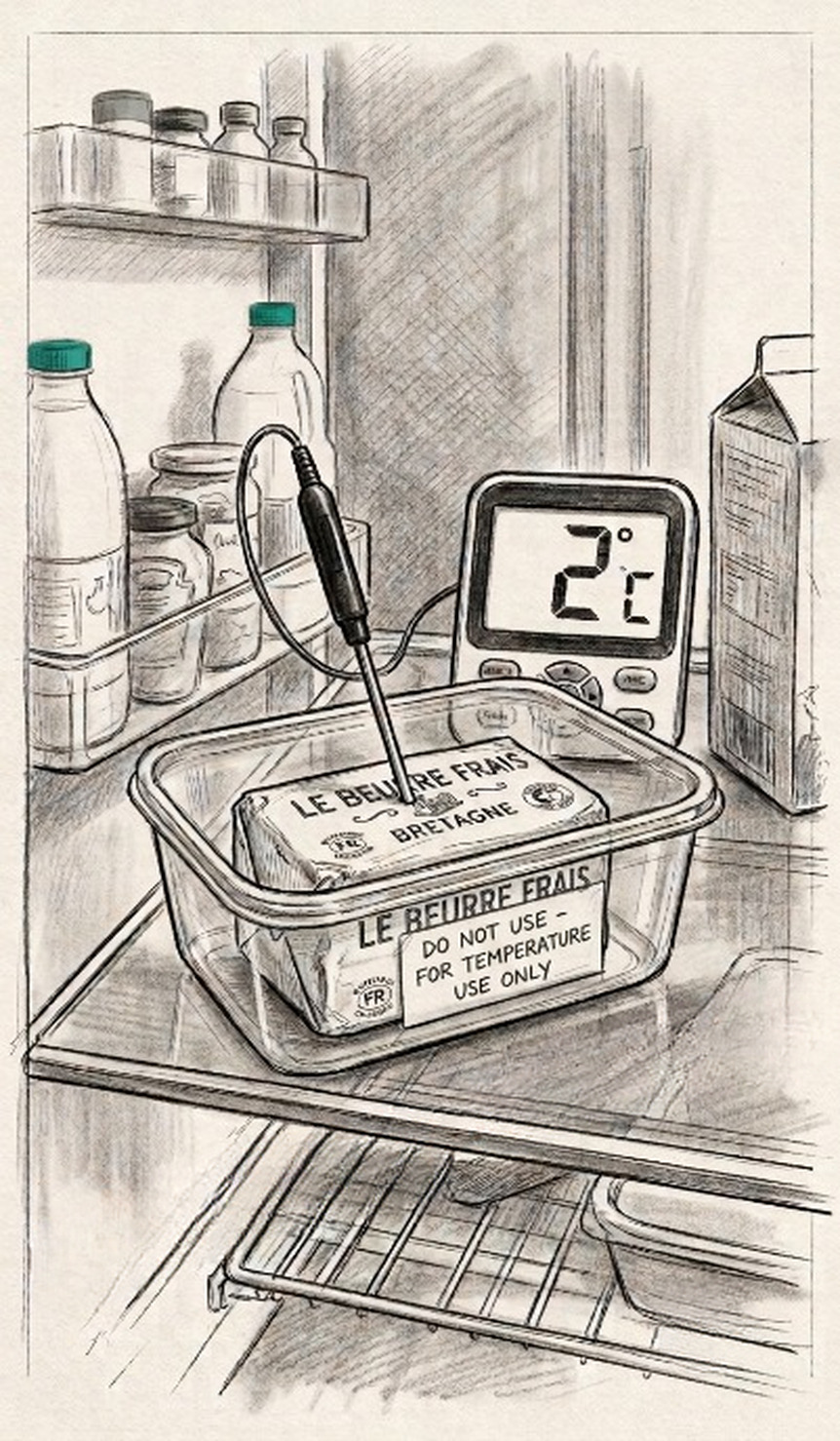
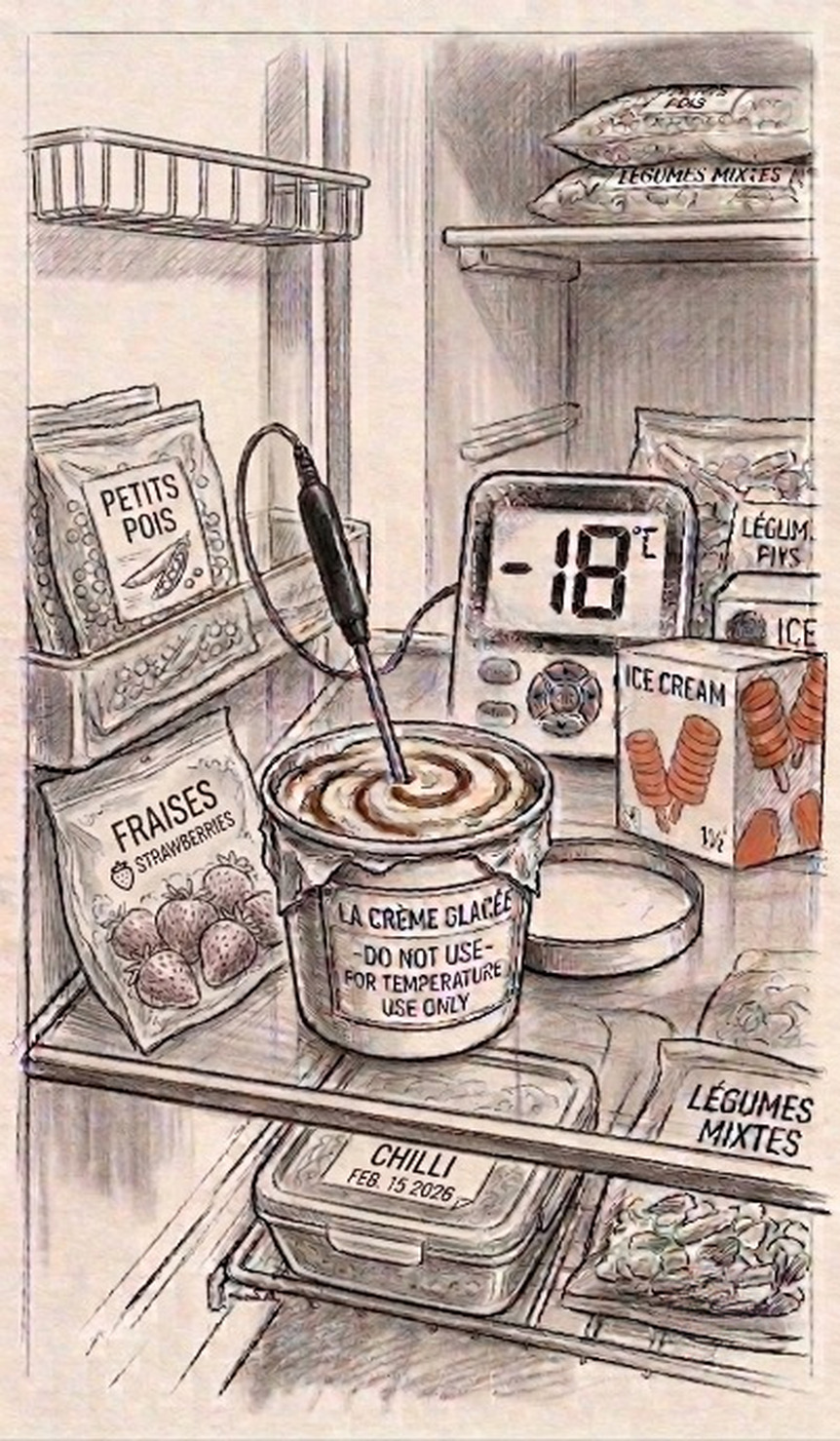
If your fridge or freezer has a digital read-out, make a point of checking it regularly — because if the electricity drops off, or something goes wrong with the appliance itself, your food is at risk. If you don’t have a digital display, pop your temperature probe into the butter or the tub of ice cream for an accurate reading. You are aiming for 4°C (40°F) or below in the fridge, and −18°C (0°F) in the freezer.
Kitchen habits aren’t just about cleaning. A clean kitchen that’s storing food incorrectly is no safer than a kitchen that hasn’t seen a mop in weeks. But focusing on cleaning alone misses the point. It’s easy to write a list of things like clean the hob, wipe the counters, the fronts of the fridge and freezer and don’t forget the handles. But I can’t write that list for you — my kitchen doesn’t look like yours, and yours doesn’t look like your neighbour’s.
The same goes for any habit, really. Creating a new habit means consciously repeating the same action until it becomes second nature — until you do it without thinking. Storing and labelling food sounds like a marvellous idea, but if you’re not actually going to do it every time, you run the risk of finding another mystery item at the bottom of your freezer next year.
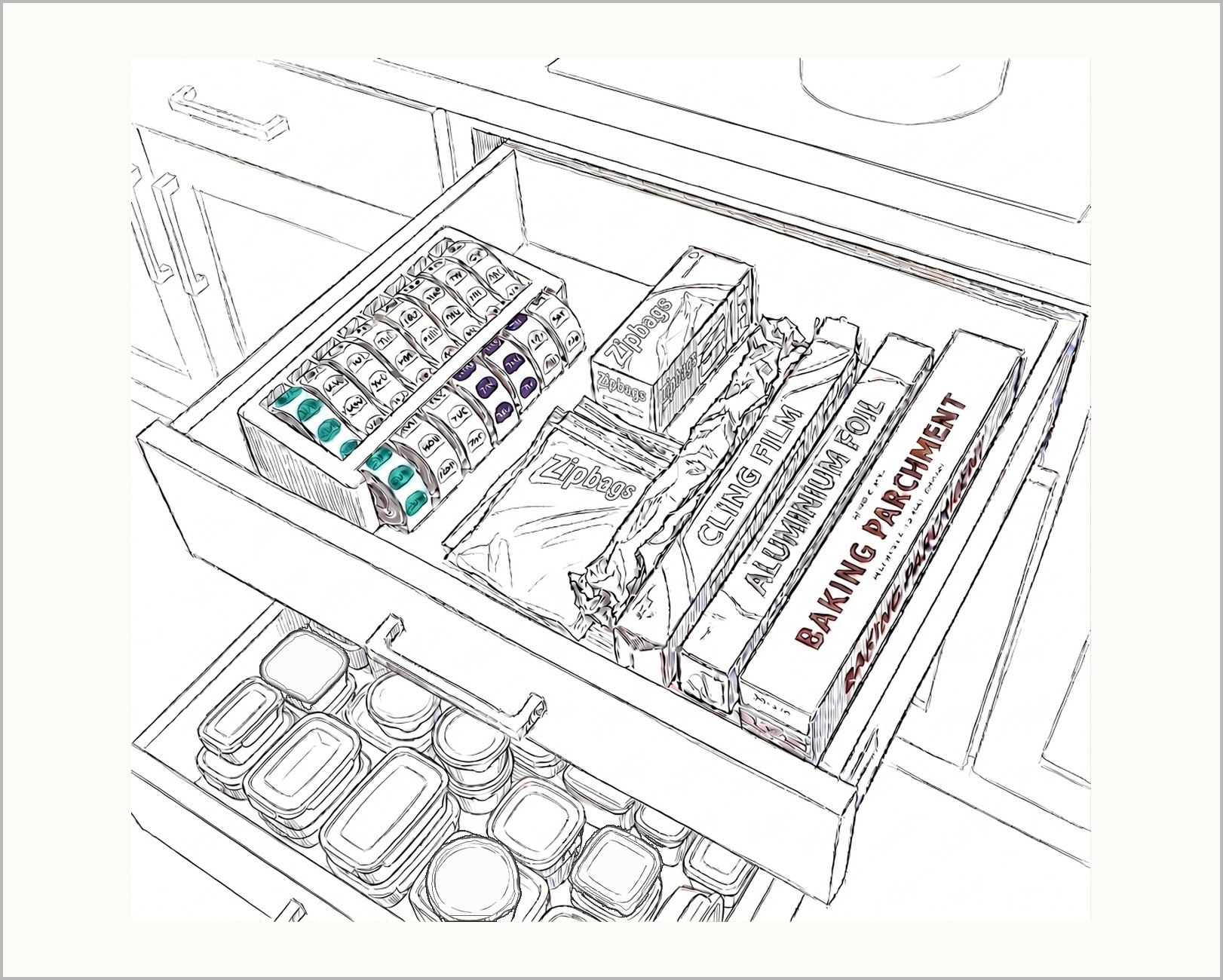
What do you need to do to make it as easy as possible to take on the new habit of labelling? Does this mean ensuring you have enough storage containers — with matching lids — zip bags and labels conveniently to hand? It’s all well and good to store items properly, but if they don’t make it onto the Freezer List, they could very well end up sitting at the bottom of your freezer, labelled but unloved and forgotten. Is using a temperature probe unnatural to you? Make it your best friend. Take it out when you start your prep, grab the probe wipes and start using your temperature probe regularly — you’ll soon wonder how you cooked all these years without one.
Whenever we had a new starter in the kitchen, they were always presented on day one with a temperature probe, a calculator, digital scales and a notebook. Most of them were not used to working regularly with a temperature probe — some had rather shockingly never used one at all. The notebook was for writing down prep quantities; if you were preparing cakes for four hundred people, you had to do the maths. And every single one of them couldn’t do basic maths in their heads. Kitchen Assistants had never used digital scales, and labelling and storing food? Those that queried what was the point were swiftly on their way. But every single one of them had developed solid habits within a few months — even working out basic maths in their head. The fact is, most people don’t like change. But when it is broken down and woven into daily life, the fear of change goes away and the habit is formed.
The notebook is worth keeping for yourself too, though your version doesn’t need four hundred portions in it. I’ve already told you how mine works in My Planner. In my world the notebook is crucial to my kitchen habits. One cheap notebook can change your life. Who knew?
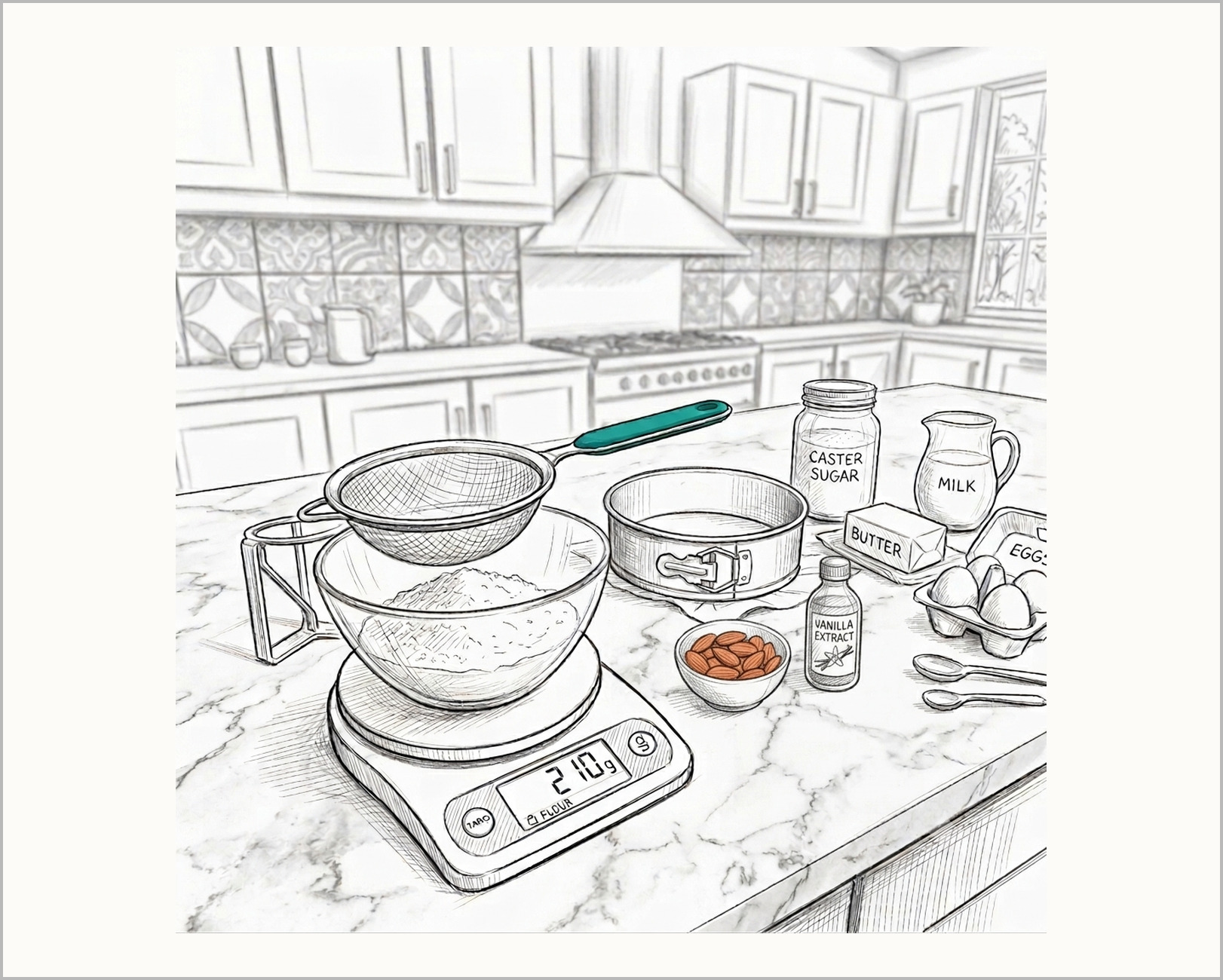
Weighing up ingredients. I’ve worked with people who really object to this for some strange reason. You can intellectualise that ingredients are essential to a recipe, but being precise? A lot of people seem to think they can just toss some ingredients together and it will magically turn out like the photo on Pinterest. Sadly, it doesn’t work that way. This is particularly true for those who largely rely on measuring cups. A cup of flour can vary significantly depending on how it’s scooped, sifted or packed — it simply isn’t precise. Weight is weight. 250g is always 250g and 13 ounces is always 13 ounces.
Quantities are there for a reason. If you’re making a savoury stew, the correct ratios matter — the right amount of vegetables to liquid, to garlic, onion, herbs and salt. If it’s a quiche, the same applies. Baking is a science — ingredients such as baking powder or bicarbonate of soda are active, and if they are not used in the correct quantities, the end result most likely will not be edible. So why don’t most people weigh their ingredients properly? Habits. Bad ones. The mindset of cutting corners is really unacceptable in a kitchen — rationalising that you don’t have to do it, that you will save some time, that you can just toss in this or that, and sometimes you can do just that. But, unless you are okay with binning a lot of food — which is ultimately a waste of time and money — do yourself the favour of forming the “weigh it up always” habit.
Every habit above attaches itself to something you’re already doing — you label as you put something away, you probe as you cook or bake and often as you serve, you weigh as part of your prep. None of them ask you to set aside time on their own; they ride on the back of a task that was happening anyway. The weekly meal plan is different. Nothing is already happening for it to attach itself to — it’s a block of time you have to find and defend, which is exactly why it’s the first thing to go in a busy week. If you want it to stick, don’t treat it as a task on its own. Tie it to something that already has a slot in your week — Sunday morning before anyone else is up, coffee in hand, or whatever works for you. Attach the plan to a moment that’s already spoken for, and it stops needing one of its own. I refer to my planner and notebook daily. If I get an idea, I can quickly pop a note onto next week’s planner and attach a recipe onto the clipboard.
When I was growing up, my mom used Friday as the cleaning day — she wanted everything tidy and prepped for the weekend so she could give herself a breather. Us kids — there were six of us — had chores allocated every week, every month or so, maybe seasonal. These weren’t written down on a rota. She didn’t have to do that — we were told, and then we just knew. We knew we didn’t have to remove all the books from the bookshelves when we dusted weekly — we knew that was for every month or so. Likewise, when thinking about your own kitchen, ask yourself: what happens weekly, and by whom? How much time do I have? Can I get my teenager to take on some of the work? Perhaps I should give this to the cleaner. And more importantly, what do we do, and how often?
Look around your kitchen. Really look. A kitchen is a kitchen — we have a stove, counters or benches as we call them, a sink or two with traps to collect the bits. Maybe a dishwasher, definitely a fridge and an oven. Cabinets, lights, walls and floors. Do you have a microwave and a garbage disposal? Do you have a separate deep freezer? Where does it live? High ceilings, low ceilings, windows, shutters, curtains or blinds. Lights on the ceiling, under the counter or hanging. Ceiling fans, extraction hoods, cleaning cupboards and junk drawers. Everything needs its place and everything needs to be cleaned and maintained. Let’s start with the cleaning, because this habit feeds all the other habits we are discussing.
Start with a clean slate. Write down everything that you just observed — everything, including the lights, the ceiling fans, the beams way up there in those high ceilings, and those gorgeous kitchen objects you seem to collect from every place you visit. Work out what needs to be done weekly, monthly, quarterly or even annually.
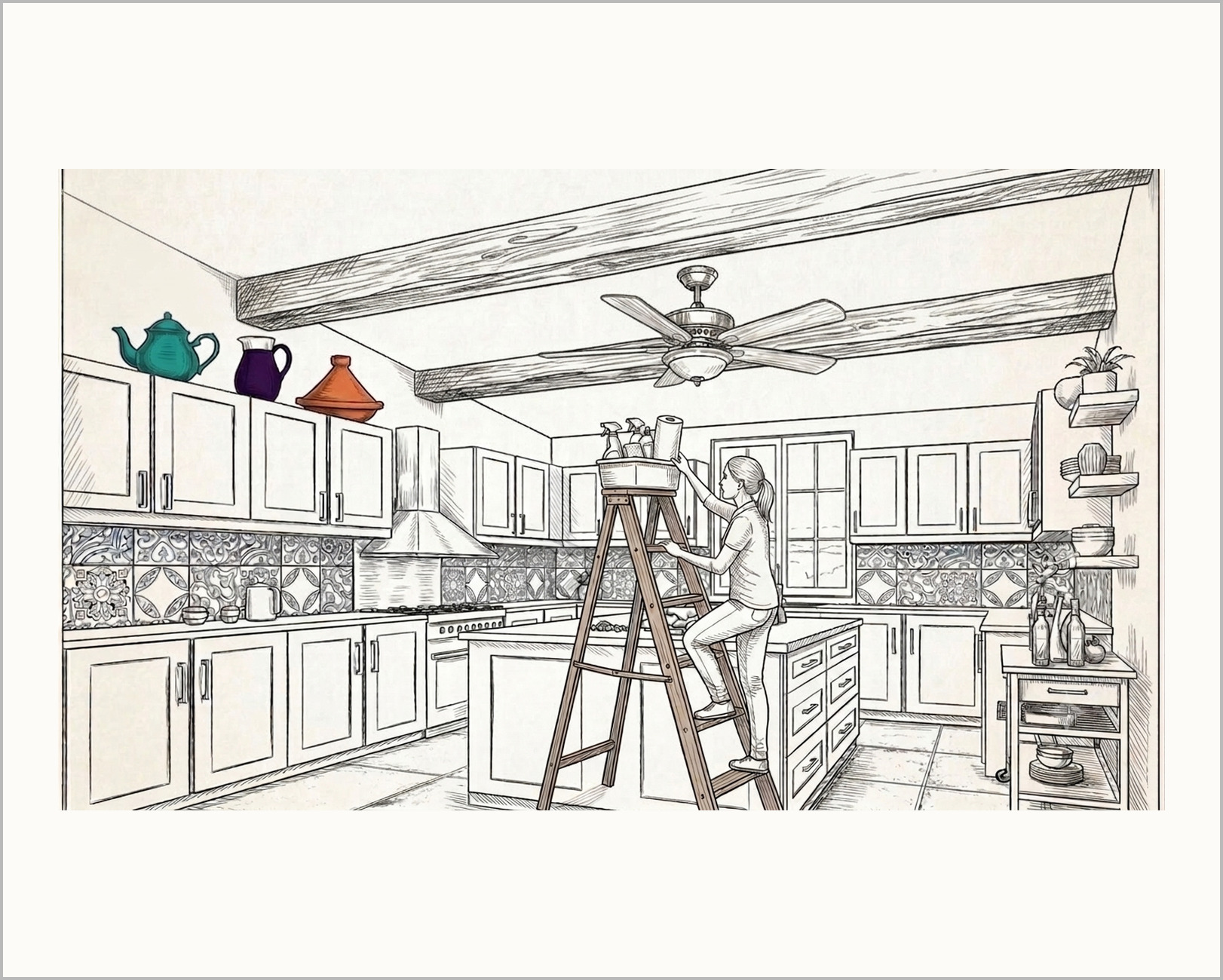
Ceiling fans — when did you last clean those? Every time they’re switched on, dust and grease that has built up on the blades is thrown straight into the air above your food preparation area and lands in that pot of stew simmering away ever so beautifully on the hob. Do you periodically remove the blinds and give them a good clean? What about the inside of the dishwasher? Have you ever moved the fridge and freezer? It can be scary when you find out what’s behind there. Do you wipe down the surfaces and walk away without cleaning the sink or the traps? Are there pests? Flies are pests, so are roaches and rodents. What are you doing to prevent them or reduce them?
Tick each item off the list when you allocate it to your cleaning rota. When every single issue is ticked off the list — and I can’t do this for you — you have the basis for a Cleaning Schedule. Don’t go to all this effort unless you are actually going to implement it. Deciding that clean ceiling fans are a good idea is a start, but without implementation it stays exactly that — an idea.
“I can’t clean the ceiling fans or the pendant lights because I can’t reach them” is not an excuse. That becomes part of your risk assessment and you figure out what is required to actually get the job done. A ladder and someone who is not afraid to climb up it; if it’s not you, then give the job to someone else, but make sure the job gets done. My sister did exactly that. Once I showed her the system, she worked out she was never going to be the one up a ladder, and decided to hire a cleaner once a month to stay on top of the big jobs. Good call.
Are there several large jobs that require a ladder? Can you clean the insides of your windows safely? Does your freezer require manual defrosting? Work it out and make yourself a rota. Give it to your cleaner, your housekeeper, your butler, your kid or your partner — stick the weekly list on your fridge and keep at it until it becomes habit, whoever is doing it. Just make the lists and do it.
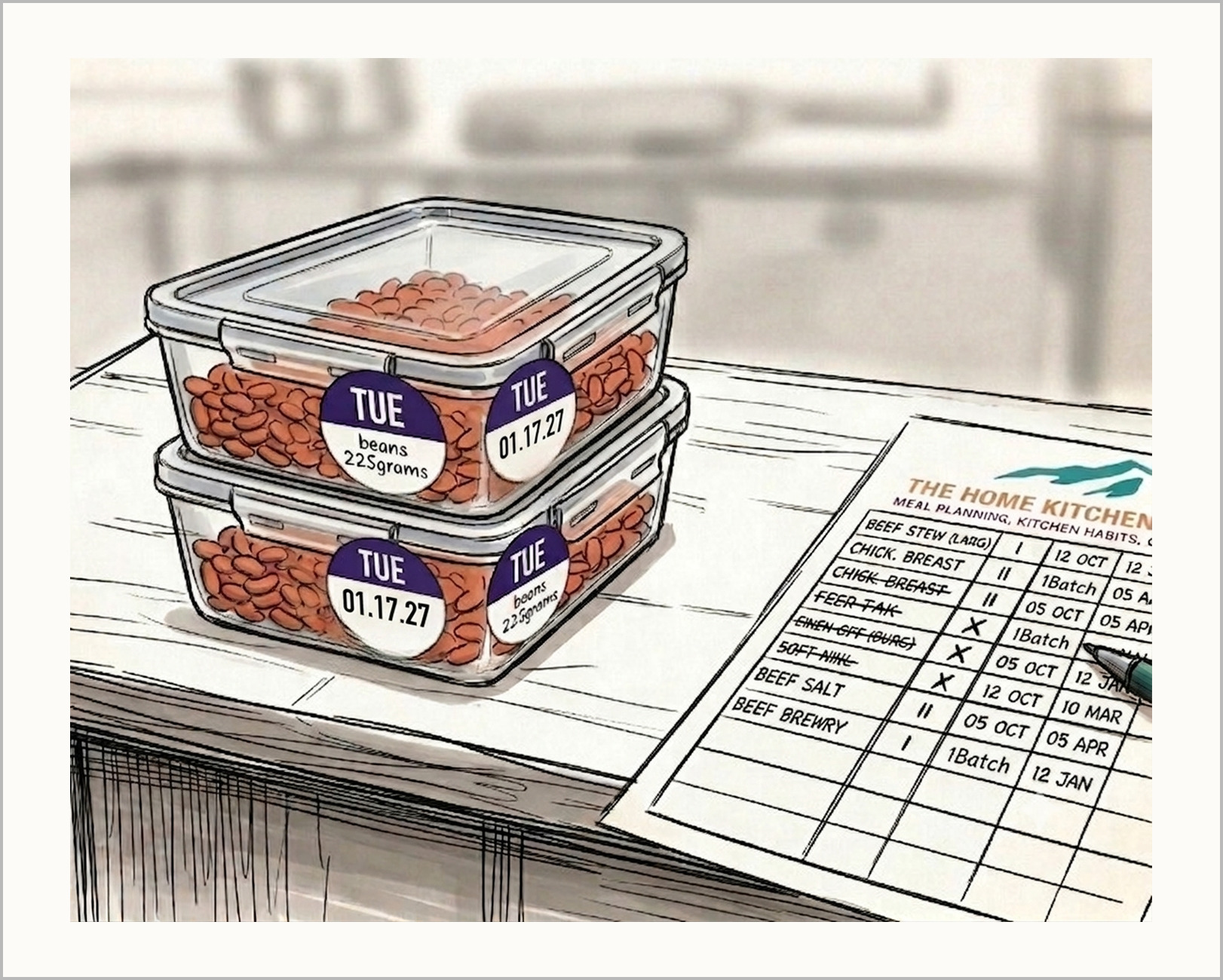
All your blank templates — a Cleaning Schedule, your Stock List, your Freezer List, your Meal & Prep Planner — are with your printables, ready to download. Print them, use them. That’s all there is to it.
What follows is my own list, and where I decided each job belonged. Unless your kitchen looks exactly like mine, your list won’t look like my list.
Everything I wrote down when I looked round my own kitchen.
| What I wrote down | How often | Notes |
|---|---|---|
| Hob and oven front | Daily, as I cook | |
| Counters | Daily, as I cook | |
| Sink and taps | Daily | |
| Sink traps | Daily | |
| Splashback tiles | Weekly | The whole cooking area is tiled, so this covers the walls too |
| Floor — sweep | Daily | |
| Floor — mop | Weekly | Unless it needs doing midweek, which it often does |
| Cabinet fronts and handles | Weekly | |
| Fridge and freezer fronts and handles | Weekly | |
| Fridge inside — quick wipe, old food out | Weekly | |
| Fridge and freezer door seals | Monthly | Concertina rubber — wipe inside the folds with sanitiser. Check for cracks or the seal pulling away; a failed seal means the fridge is not holding temperature. |
| Fridge inside — shelves and drawers | Monthly | |
| Behind and underneath the fridge | Quarterly | |
| Dishwasher front and handle | Weekly | |
| Dishwasher — cleaning cycle | Monthly | |
| Oven — deep clean, roof, sides, door glass | Quarterly | |
| Bins and bin lids, inside and out | Weekly | Under the lid as well |
| Garbage disposal | Monthly | |
| Extraction hood exterior | Weekly | |
| Extraction hood filters | Quarterly | Degrease or replace |
| Deep freezer — pull out, clean behind and underneath | Quarterly | Mine lives in the laundry room, but it belongs on the kitchen schedule |
| Deep freezer — defrost, if not frost-free | Bi-annually | Mine is frost-free, so this is not a job here. If yours is not, it needs a place on your schedule. |
| Disposables drawer — foil, cling film, parchment, zip bags | Monthly | Wipe it out and see what’s running low, both jobs at once |
| Container cupboard — every lid matched to a box | Monthly | Anything without a partner comes out — keep a few of the small ones for weighing up (Golden Rule 7), the rest go |
| Labelling kit — dots, labels, pen | Monthly | Keep it all in one place you can reach without thinking. Hunt for it every time and you will stop bothering. |
| Probe wipes and batteries | Monthly | Check and replace |
| Temperature probe — calibrate | Monthly | |
| Dry goods — expiry dates, pests, airtight seals | Monthly | Mine live in jars on a trolley — barley, lentils, chia seeds. Wipe the lids where dust collects, then lift the jars off and wipe the shelves. |
| Junk drawer | Monthly | Empty it. Get rid of the superfluous — what are needle-nose pliers doing in a kitchen drawer? Put things where they belong. |
| Cleaning cupboard | Monthly | Mine holds the mop, the bucket and the broom — and a shelf that collects everything else |
| Under the sink | Monthly | Where the bleach and the sprays live. Things get chucked under there and forgotten, so it needs a proper look. |
| Under-counter lighting | Monthly | Wipe the fittings and diffusers — they sit directly over the food |
| Windows, inside and out * | Monthly inside, bi-annually outside | Mine sit three metres up, so the outsides could be a working-at-height job — but I live in France, and they open inwards, so I can reach them from a ladder inside |
| Pendant and ceiling lights * | Quarterly | |
| Ceiling fan blades * | Quarterly | |
| Tops of the wall cabinets, and what’s stored up there * | Bi-annually | |
| Ceiling, beams and cobweb corners * | Bi-annually | |
| Every cupboard and drawer — emptied, cleaned, reorganised | Annually | |
| Blinds and shutters — taken down and cleaned * | Annually |
What to do with this. Once your list is written, transfer it onto the blank schedules — one sheet per frequency. Weekly on one, monthly on another, and so on. If a frequency runs long — mine has fifteen monthly jobs — split it across two fortnightly sheets rather than facing the lot in one go. On rotation it is far more manageable. The jobs marked * are worth pulling onto a sheet of their own, so whoever is doing them has the whole lot in one place.
* Working at height. These need a ladder. For a high ceiling, a platform ladder or a hired push-around lift.
The professional code. Now yours.
Obvious? Yes. Non-negotiable? Absolutely. Before you cook, between tasks, after handling raw meat or fish. Twenty seconds with warm soapy water — you may remember the Covid handwashing drill. Same rule, same standard. Every time, without exception.
Your fridge keeps your food safe. Keep it between 1°C and 4°C (34°F and 40°F), and your freezer at −18°C (0°F) or colder. Check them regularly.
The oldest food in your fridge, freezer or cupboard is always used first. Tins, jars, packets — move new stock to the back, bring older stock to the front. It’s the simplest habit in any professional kitchen, and the one that all but eliminates waste. Voilà.
Raw meat and fish have no business anywhere near food that’s cooked or ready to eat. Keep them well apart from anything going straight to the plate — a salad, cold leftovers, a slice of bread, a bit of cheese. Different chopping boards, different surfaces, different containers. And in the fridge, raw always sits on the bottom shelf, so nothing can drip onto anything else.
A temperature probe is a small, inexpensive digital device that tells you the exact internal temperature of whatever you’re cooking. It takes every last shred of guesswork out of the kitchen.
Without fail. Whether it’s pasta on the hob or a tray in the oven, set a timer the moment it goes on or in. Don’t trust memory, don’t trust smell alone — by the time you can smell it, it may already be too late.
Chefs call it mise en place — French for “everything in its place”. Gather and weigh your ingredients, mince the garlic, slice the leeks — whatever the recipe requires — and have it all ready before you start putting the dish together.
In a professional kitchen nothing goes into a fridge, freezer or container without a label. Contents and date, every single time.
A freezer is only useful if you know what’s in it. Every time something goes in, it goes on the Freezer List; every time something comes out, it gets crossed off. It takes seconds, and it’s the difference between a freezer you shop from and a freezer you dig through.
Your tools, your chopping boards, your herbs and spices, your store cupboard basics. Everything lives somewhere, and everything returns there clean, dry and in order.
Don’t wait until the end of cooking to tackle the mess. Wipe down as you work, wash up as you go, put things away the moment you’re finished with them. By the time dinner’s on the table, your kitchen should be more or less back to order.
If you’re not sure whether food is still good, it isn’t. No meal is worth the risk. If it smells off, looks wrong, or you can’t remember when you made it — bin it. This is exactly why Rule 8 matters.
So — would your kitchen pass an inspection? Maybe not today. But I suspect it will soon.
That was my honest answer too, even after a career in the business.
Reading back over The Home Kitchen System, I can see it is a lot of work. It can feel intimidating, and it’s fair to think, ‘It’s easy for her — she moved into a new kitchen.’ That’s true. But here’s the thing — I didn’t write this system, much less implement it, until I’d been in the house over a year. So, when I asked myself when I’d last actually swept and mopped the kitchen floor, that was a genuine question. And I was mortified when I answered it. That’s the important bit: we tell ourselves all kinds of tales to justify ourselves to ourselves, and this system only works when we’re honest about the state of our own kitchens.
A few years ago, I had to take a driving test — my licence had expired. I failed the first two. I’d been driving so long that I’d picked up some really bad habits. So, I signed up for a course of six lessons with an instructor who pointed out every single one — and there were a lot. We all have bad habits. We cut corners, thinking we’ll come back and do that later. Then later comes and goes, and we never do it.
You may be starting out with an organised and tidy kitchen, and if that’s the case, wow! Good for you. Most of us aren’t there yet. I’m still looking at a junk drawer that literally has a lightbulb rolling around loose in it, and other things that belong anywhere but there.
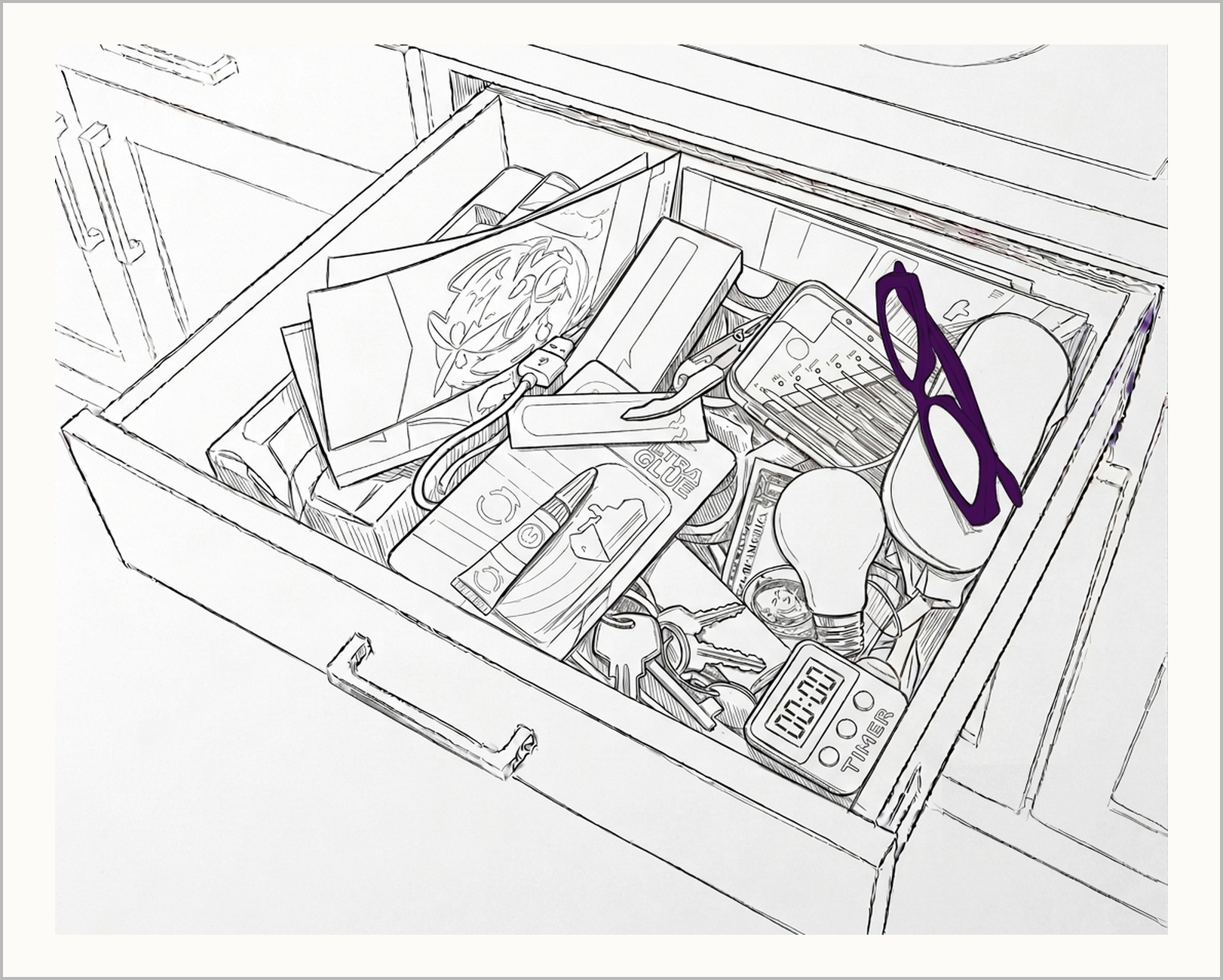
Take the material in here and implement it however slowly or quickly you like, or have the time for. Thinking you need to magically clean out all your cupboards, pantry, fridge, freezer and junk drawers before you can implement the principles we’ve just discussed would be unfair to you. Commit to one thing. That shelf, for example, to start. You know which one — that top shelf in the pantry that has hoover bags sitting precariously on top of a box of outdated product guarantees, with an electric lead slung over the top. And be honest with yourself: none of those items should be living anywhere near your kitchen pantry.
And to be really fair? You can start and efficiently work a Freezer List with those hoover bags on that top shelf for the next five years. But starting that Freezer List is a first step.
We have to start somewhere — and it can be the planner. Fill in next week, however roughly. Start the Freezer List, and suddenly the freezer row has something to read from. Sort the cupboards and set up a labelling station, and you stop defrosting mystery tubs. Write your Cleaning Schedule, and your kitchen stays in a state you’d happily cook in. Take on as much or as little as you like, in whatever order suits you; every piece you add makes the planner easier to work, and the planner is where all of it pays you back.
And unless you live alone, you shouldn’t be doing all of this on your own. Who else lives in your house? They eat there too, so give them some of the jobs as well.
None of that happens in a week. It doesn’t need to.
But when you’ve developed the habits of a professional kitchen — when you can put hand on heart and say your kitchen would pass inspection — you’ll have the answer to the question we started with. When that day comes, we’ve both done our job — and yours was way bigger than mine.
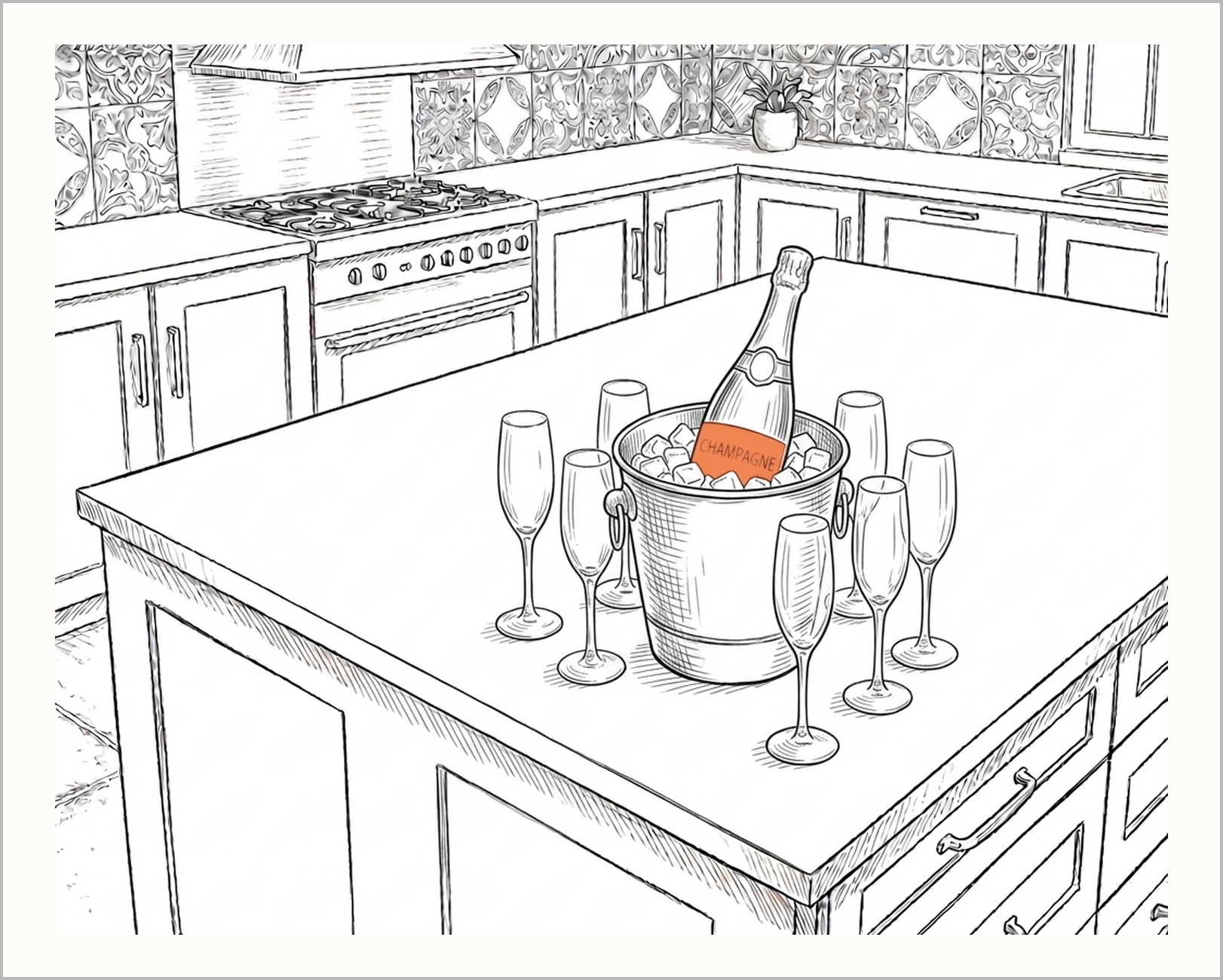
Now go and put a bottle of bubbles on ice. You’ve earned it 🙂
And let me know how you are getting along with The Home Kitchen System.
Cheers
Dawn Phelps studied at Le Cordon Bleu and went on to run large multi-site contract catering operations, then her own catering company, where she devised what became The Home Kitchen System. She lives in southwest France.
The Home Kitchen System is a guide to good kitchen habits, drawn from my years in professional kitchens. It isn’t a set of rules or legal requirements, and it isn’t medical, dietary or nutritional advice. Take what works for your household and leave what doesn’t.
The storage times, temperatures and practices in this guide come from my own professional practice. They are guidelines, not official advice. Always follow the dates and storage instructions on the packaging and the instructions for any equipment you use, keep your fridge and freezer at the right temperatures, and use your own judgement. If in doubt, throw it out.
Neither The Home Kitchen System nor its author can accept responsibility for food that spoils, or for any illness or loss arising from how food is stored, prepared or cooked. Nothing here limits your rights under consumer law.
If you, or anyone you cook for, has a food allergy or follows a diet for medical reasons, the advice of your doctor or dietitian comes first.
© 2026 The Home Kitchen System. All rights reserved.
All the writing, illustrations, planner, lists and designs in The Home Kitchen System are protected by copyright. When you bought it, you bought a personal licence to use it in your own home. Print the planner and lists as often as you like for your household.
Please don’t copy, share, resell, republish or distribute any part of it, and keep your private link to yourself.
You may not upload, paste or otherwise feed any part of The Home Kitchen System into an artificial intelligence tool or service to copy, summarise, reproduce or regenerate it. Nor may you use any part of it to train or develop an AI model. We expressly reserve our rights against text and data mining of this content.
All illustrations were created using AI tools from photographs of my own kitchen here in France. The writing is my own.
Email hello@maisonbonhomie.com